Generative engine optimization (GEO)
Generative engine optimization (GEO), also called AI SEO, is the work of getting a business named, and described correctly, when buyers ask ChatGPT, Gemini, Claude or Google’s AI Overviews: which sources these systems draw on, what they say about the business, and whether that brings inquiries. As a GEO consultant I work from the baseline measurement to fixing the sources and the pages, and I measure again with the same questions.

When you need generative engine optimization
Generative engine optimization is needed when buyers already ask AI assistants, and the answer doesn’t name your business, or doesn’t describe it the way it should. These are the situations in which companies most often look for a GEO consultant:
You rank well in Google, but ChatGPT recommends a competitor. Sometimes a much smaller one. Publishing more of your own content hasn’t changed that.
A prospect said they asked an AI, and you weren’t on the list. The shortlist was made without you, before anyone looked at your website.
AI gets wrong what you do. It quotes an old price, a missing feature or an old address, or mixes you up with another company, and the prospect brings that to the sales call.
Rankings hold, clicks fall. Fewer people click on informational searches because the answer already shows on the results page, and you can’t tell how much of that is AI Overviews.
You can’t see whether AI search brings anything. It doesn’t show separately in analytics, the tools disagree, and the same question gets a different answer every time.
Leadership asks for an AI strategy. After a conference or a video they ask whether you’re “GEO optimized”, and you can’t say which part of it isn’t SEO.
You’ve paid for GEO or AEO, and you can’t see what changed. The report shows a score, but not for which question, on which platform, or because of which source.
GEO and SEO: the same foundation
GEO builds on the same foundation as SEO: the work of technical SEO, website content strategy, off-page SEO and web analytics. AI assistants run a search before they answer and write from the pages they find, which is called retrieval-augmented generation (RAG). What a search engine can’t see, the assistant can’t find either. AEO (answer engine optimization) and LLM SEO are other names for the same work. GEO here doesn’t mean geotargeting: search by location is part of local SEO.
The difference is in three places:
The term GEO comes from a 2023 Princeton study that measured which content changes increase a source’s weight in a generated answer. Citing sources, adding quotations and adding concrete data helped most.
AI search platforms: where Google, ChatGPT, Claude and Copilot get their sources
AI search platforms differ from traditional search in that each draws on a different search engine or index, so the same business can appear in one and not in another. In my own measurement in August 2026, for the same buyer question ChatGPT ran twelve sub-queries, eight of them restricted to specific websites, and Gemini ran three, with no restriction. So I measure each platform separately, with the same questions:
Google: Gemini, AI Overviews and AI Mode. These draw on Google’s own index. What’s needed here is the SEO foundation: your pages indexed, and Search Console monitored. Google says its AI features have no extra requirements, and the Google-Extended setting doesn’t affect whether a site appears in Search, AI Overviews included. Search Console has a separate report that shows how often your pages appeared in AI Overviews and AI Mode; it gives no clicks or queries, and doesn’t separate the two.
ChatGPT. ChatGPT searches several sources: its own index and results from other search engines. OpenAI doesn’t publish the mix, and measurements show it has changed several times since 2024. What’s needed here: OpenAI’s search crawler, OAI-SearchBot, must be able to reach the site, because according to OpenAI, blocking it keeps your pages out of ChatGPT’s search answers; and the site should be in Google’s and Bing’s index too. Since November 2026 a business can claim its profile in ChatGPT’s Business Hub: it can update its business and product information, and see how often ChatGPT mentioned it, how many clicks followed and which topics people asked about. It doesn’t show the questions, and it shows no data below a minimum volume.
Claude. Claude’s web search runs on Brave Search, which has its own index and its own crawler. What’s needed here: your important pages in Brave’s index, which you can check directly in Brave’s search engine.
Copilot. Microsoft Copilot draws on Bing’s index. What’s needed here: Bing Webmaster Tools and IndexNow, so changes get picked up quickly. The AI Performance report in Bing Webmaster Tools shows how often Copilot cited your pages, which pages and for which searches; it gives no clicks.
The models change: a new version or a new search setting, and the same question brings different sources. What sits in a model’s trained knowledge only updates with the next training round. None of the providers publishes exactly how an assistant picks its sources, so it has to be measured, not guessed.
GEO audit: what I check
A GEO audit checks what AI assistants say about the business today, where they get it from, and what it takes for the business to appear more accurately and more often. These are the areas, and what I check in each:
Questions and answers. I build the question set from your buyers’ real questions, from sales, support and search data, not by generating them. I run twenty to forty questions several times on each platform, and record who appears in the answer, in what order and in what context. I also check which questions are worth it for you at all: not every question is one where you need to appear.
Cited sources. For every answer I note which pages the assistant cites. In most categories a handful of recurring sources make up most of the answers: list articles, review sites, trade publications, forum threads, competitors’ pages. That shows where you should appear, and where your competitor does.
Entity and business data. The assistant has to know who you are: the same business name, description, products and address on your website, in business profiles, in directories and in knowledge bases, in every language you use. I check the tone and the claims it makes about you, and where you’ve been mixed up with another company.
Your own pages. I check how easily an answer can be lifted from your pages: whether the first sentence of a paragraph names its subject, whether there’s a structure that answers questions, concrete data, sources and dates, and whether prices and product data are current. I check the signs of expertise (author, experience, case studies), the structured data (Schema.org in JSON-LD), and whether the language versions say the same thing. Planning the content in detail is part of website content strategy.
Technical access. Whether AI crawlers can reach your pages: robots.txt, CDN and firewall rules, canonical URLs and indexability. Many assistants don’t run JavaScript, so I check whether the content shows without server-side rendering. Server logs show which AI crawlers have visited. I also check the CMS settings, IndexNow and llms.txt. A detailed technical review is part of technical SEO.
Measurability. I check whether traffic from AI assistants shows separately in analytics, whether your forms ask how people heard about you, and whether the platforms’ own reports are set up: the AI report in Search Console, the AI Performance report in Bing Webmaster Tools and ChatGPT’s Business Hub.
Wrong facts in AI answers: what can be done
A wrong fact in an AI answer (a wrong price, a missing feature, an old address, being mixed up with another company) usually comes from a source, and the source can be fixed. The platform writes the answer, so I don’t promise it will correct it. This is how I work:
I find where the error comes from. If the answer cites sources, the wrong claim is usually in one of them: an old list article, an outdated review, another company’s page. If it cites nothing, the error may come from the model’s trained knowledge.
Your own pages first. Your price or how pricing works, your features, certifications, address and who the product is for should be stated clearly on your website, not in a PDF or behind a login. If pricing is custom, the page should say so.
Then the public sources. Business profiles, directories, review sites and knowledge bases should say the same thing: the same name, description and data. Where the owner of a source accepts corrections, we ask for one.
Your own profile on the platform. In ChatGPT’s Business Hub a business can claim its profile and correct its business and product information; OpenAI says ChatGPT may use it in answers. For a local business, Google’s AI summary also draws on Business Profile data, so the address, service area and opening hours need to be right there too.
Reporting it to the platform. Google’s AI Overviews and the assistants all have a way to send feedback. We report the error with evidence; the platform decides whether to correct it.
Trained knowledge changes more slowly. What’s in the model can stay until the next training round. Until then, the answers that draw on search can be corrected, which is why fresh, accurate sources matter most.
Re-measurement. I run the same question on the same platforms again and check what changed.
How I work: the GEO process
GEO has seven steps for me. I look at the same questions and metrics before and after the work, so you can see what each change delivered.
01
Discovery
The first step is the goal and the situation: what you sell, to whom, in which market and language, and for which buyer questions you should appear. We settle who owns the business data and the messaging (marketing, product, PR), because GEO work touches several teams. Access to analytics, Search Console, Bing Webmaster Tools and ChatGPT’s Business Hub stays with you.
02
Baseline
The baseline records where we start. I run the question set several times on each platform, because every run gives a slightly different answer to the same question, and I also review the answers by hand. I record how often and where the business appears, who appears instead, which sources the assistant cites, and what it says about you. The platforms’ own data completes the picture: the AI report in Search Console, Bing’s AI Performance report, ChatGPT’s Business Hub, and analytics.
03
Audit
The audit goes through six areas: questions and answers, cited sources, entity and business data, your own pages, technical access, and measurability. The result is a prioritized task list.
04
Strategy and roadmap
The strategy says which questions and which platforms to start with, and what comes first: access, your own pages or outside sources. We start with a small group of pages or questions, measure the effect there, and extend it if it works. In the roadmap every item says who does it, how much work it is, and which metric it will show up in.
05
Implementation
Technical fixes and page rewrites are done by your team from my write-ups, or by me where that’s faster. For outside sources I tell you which list, review site or trade publication is worth getting into and why; the outreach is done by your PR or marketing team, or by me under a separate agreement. I tell you up front how much time it needs from your team.
06
Monitoring and reporting
Monitoring means running the question set regularly and following model changes: when a platform switches to a new version, the answers can change overnight. Every month or quarter you get a report: what changed, on which platform, and what comes next. I only recommend a tool if its method is transparent.
07
Re-measurement
Re-measurement uses the same question set on the same platforms as the baseline. I look at how often and where the business appears in the answers, how often your pages are cited, and your share compared with competitors; and whether what the answers say about you is accurate. Next to that I put the platforms’ own figures: Google AI impressions, Copilot citations, and ChatGPT mentions and clicks. Traffic from AI assistants gets its own channel in analytics, and a “How did you hear about us?” question on the form catches the people who learned about you from an AI and came back later directly or through a branded search. Where possible I work with a control group, comparing pages that were changed with pages that weren’t, because AI answers move on their own. Measurement follows GDPR and runs with consent, so analytics doesn’t see everyone. I state what can’t be separated out: model changes, PR, ads and seasonality.
Proof
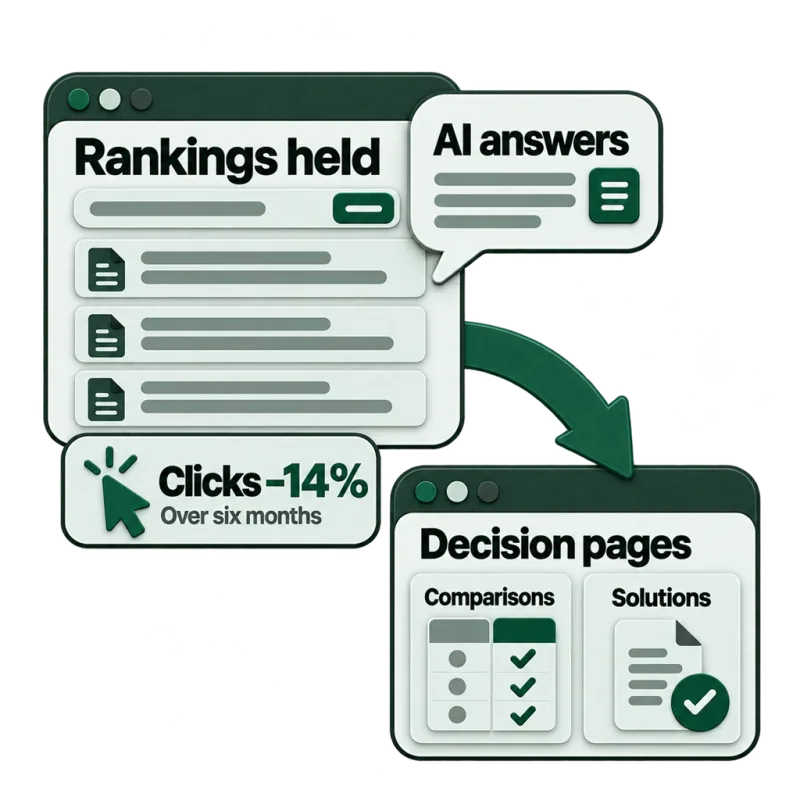
−14%
Organic clicks
Clicks, rankings unchanged
A B2B SaaS case: positions held across the period, clicks dropped 14%. The answer moved into the AI summary.
Case study: losing clicks to AI search
Own measurement · anonymized client project.
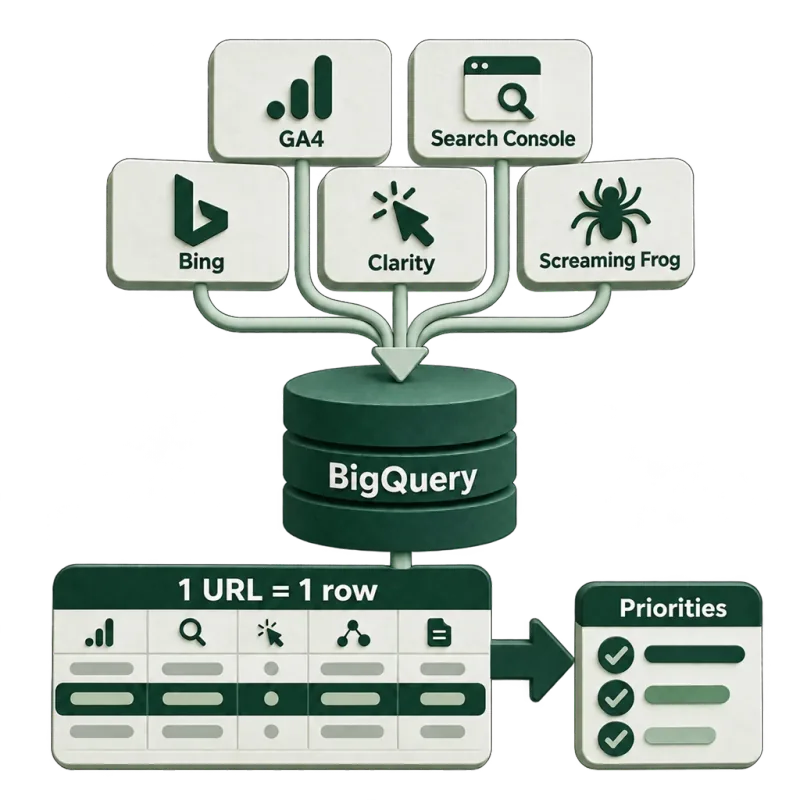
68%
of new-user demo and sign-up starts are linked to organic search
An SEO data warehouse from five sources
Five sources joined by URL in one BigQuery table showed which page to fix first, and how much SEO brings beyond the last click.
Case study: an SEO data warehouse in BigQuery
Own measurement, five sources in BigQuery, 30 days.
Pricing
I charge €50 per hour. Every figure below is hours × €50, so you can see what each budget buys.
Hourly consulting€50 / hour
Example project
Website
One website
- 01
GEO audit
Twenty to forty buyer questions on four platforms, cited sources, business data, your own pages, technical access, measurability; a prioritized task list.
€800
16 h · one-off
- 02
Monthly work
Page briefs, checking what was implemented, monitoring sources, a monthly report.
€800
16 h / month
- 03
Re-measurement
The same question set on the same platforms, compared with the baseline.
€200
4 h · one-off
These are indicative budgets, not fixed prices. The platform, the number of templates, how the site is built and what the audit finds all change the final quote. Writing, outreach and development are priced separately.
No VAT is added to these figures — I’m VAT-exempt under Hungarian law.
When does GEO pay off?
GEO pays off when buyers who come through AI assistants bring in more than the consulting, the content and technical work, and your team’s time cost together. The audit costs €800. If you earn €400 on an average new customer, two new customers cover that. Some of the people who come through AI return later directly or through a branded search, so we count the answers to “How did you hear about us?” too. Delay has a price as well: while the answers name your competitor, buyers make their shortlist without you.
What the monthly budget covers
Research, strategy, implementation or coordination with your developers, monitoring, meetings and reporting. Reporting time counts in the hours.
You get access to the project management tool, where you can see the priorities, who is responsible, progress and what comes next. Each month starts with agreed priorities and ends with a review of what changed and what the data shows.
Priced separately
Content writing and production, including an external writer if needed.
Outreach and digital PR. The audit includes the backlink analysis and recommendations.
Setting up or repairing measurement. The audit analyzes your existing data; new tracking and integrations are scoped separately.
Development beyond the agreed hours, including external developer fees.
AI search research or monitoring beyond the agreed topics, languages and AI systems.
Before you start
You receive a proposal with the scope, the estimated hours, the audit fee and the monthly budget. It also states whether the first phase includes implementation, when the ongoing work begins, and what your team needs to provide.
There is no lock-in. Any change to the scope or budget is agreed before the extra work starts.
Questions
How is GEO different from SEO?
The foundation is the same: pages that can be indexed, load fast and are well structured, plus links and mentions on other sites. The difference is in the question, the sources and the measurement. The assistant breaks a question into several searches, often writes the answer from other people’s pages, and there are no rankings: only whether you appear in the answer, and what it says about you.
What does GEO cost, and what do we get?
I charge €50 an hour. A GEO audit is about 16 hours (€800): a question set on four platforms, cited sources, business data, your own pages, technical access, and a prioritized task list. Monthly work is billed for the hours used, with no lock-in.
Is an AI visibility tool enough?
I’d switch on the platforms’ free reports first: the AI report in Search Console, the AI Performance report in Bing Webmaster Tools and ChatGPT’s Business Hub. On top of that, a paid tool runs the questions regularly and counts, and that’s useful. It doesn’t help with two things: it doesn’t know which questions matter to your buyers, and it doesn’t tell you what to change. Tools can also give different numbers for the same business, so before a decision rests on a score, I check how it’s calculated.
How do we know the improvement came from GEO?
It can’t be separated out completely, because PR, SEO and model changes all have an effect. What can be done: we measure with the same question set before and after, with a control group where possible, and tie each change to a specific question and source. That shows what moved after which change.
Do we need an llms.txt file?
I wouldn’t start there. It’s a small job and does no harm, but Google says its AI features don’t need a separate file, and none of the major assistants requires one. First I check whether crawlers can reach your pages and whether an answer can be lifted from them.
Can you guarantee we’ll appear in ChatGPT?
No. The assistant writes the answer, and gives a slightly different one to the same question every time. What I commit to is fixing what appearing depends on (access, your own pages, outside sources), and measuring what changed with the same method.
Why do ChatGPT, Gemini and Claude give different answers?
Because they search different engines: Gemini uses Google’s index, Claude uses Brave Search, and ChatGPT uses several sources, its own index included. They find different sources, so they name different companies. That’s why I measure each platform separately.
How long before anything changes?
I don’t give a date. Answers that draw on search can change once the source changes; what sits in a model’s trained knowledge can stay until the next training round. The quarterly re-measurement shows what moved.
Should we allow or block AI crawlers?
There are two kinds. Search crawlers (such as OAI-SearchBot) visit so that you can appear and be cited in answers; block them and you’re left out. Training crawlers (such as GPTBot) collect data for training models; whether you allow them is a business decision. Often a CDN or firewall blocks them without you knowing, so I check that too.
Why does ChatGPT recommend a competitor smaller than us?
Because the answer doesn’t come from company size or from how much you publish, but from the sources the assistant finds for the question: list articles, review sites, trade publications, forums. If your competitor appears in those and you don’t, the answer names them. A GEO audit shows which sources these are, and which ones are worth getting into.
Want to know what ChatGPT says about you today?
Send me your website and three questions your buyers would ask, and I’ll tell you where I’d start.