B2B SEO consulting
B2B SEO consulting connects organic search to your sales pipeline: which searches your buyers run before they talk to sales, which pages answer them, and how a visit turns into a qualified lead in your CRM. As a B2B SEO consultant I work with SaaS companies, B2B service firms, manufacturers and industrial companies, and with agencies on their B2B clients, from the audit and competitor research to measurement in the CRM.

When you need B2B SEO consulting
B2B SEO consulting is needed when organic search should bring qualified leads, and today it brings readers, or nobody can show what it brings. These are the situations in which B2B companies most often look for an SEO consultant:
You get traffic, but hardly any leads. The blog brings the clicks, while your product and solution pages barely show for the searches buyers make.
Leadership asks what SEO adds to the pipeline. Deals take six months or longer to close, there are many touchpoints along the way, and the source data in the CRM doesn’t answer the question.
SEO has outgrown the team. A founder, a marketer or a developer has run it next to everything else, and nobody decides what comes first.
You rank in Google, but AI answers recommend a competitor. A prospect asked ChatGPT for a shortlist, and you weren’t on it.
Traffic or inquiries dropped. It happened after a domain move or a site merger, or with no visible cause, and nobody in-house can say why.
Hardly anyone searches for what you sell. Keyword tools show almost no volume for the obvious terms, and you don’t know whether search is worth building on.
You have several SEO proposals and can’t compare them. The packages look alike and the prices don’t. Or you’ve paid for SEO before, and you can’t see what it delivered.
B2B SEO audit: what I check
A B2B SEO audit starts from who buys from you and how, and only then looks at the website. These are the areas, and what I check in each:
Buyers and the buying journey. In B2B a purchase is usually decided by a buying committee: the person who will use the product, the one who owns the budget, and often IT, legal or procurement. Each of them searches for something different. I start from your ideal customer profile and from what your sales team hears on calls: the questions, the objections and the competitors that come up. From that I map the buying journey: what people search for when they first notice the problem, when they compare solutions, and when they check a vendor. Search captures demand that already exists. If your market first has to learn that the problem can be solved, that is demand generation work, and I tell you so.
Search demand and intent. From your Search Console data and from keyword research I list the queries your buyers use, with branded searches kept apart from non-branded ones, because branded searches come from people who already know you. For the important queries I look at the results page: what kind of page ranks there (a guide, a product page, a comparison, a list), and which features appear, such as an AI Overview. That shows what kind of page can rank for it. Every query then gets one page that answers it. In B2B many valuable queries have low search volume, so I rank them by what a deal is worth, not by volume.
Commercial pages and content. Commercial pages are the ones a buyer reads before contacting you: product, solution, industry, use-case, pricing and comparison pages. A content gap analysis shows which buyer questions have no page on your site and which ones competitors answer. I check how pages are grouped by topic and how they link to each other, in particular whether the blog links to the commercial pages. On each page I check the title, the headings, and whether it says who the product is for and what it costs or depends on. I also check what shows your expertise: named authors with real experience, case studies, sources. Planning the content in detail is part of website content strategy.
Technical foundation. The technical foundation decides whether Google can crawl, render and index your pages. I crawl the site and check indexing, robots.txt, the XML sitemap, structured data and Core Web Vitals, and what your CMS allows. On large sites with several teams and a headless CMS I also look at rendering and, where available, at server log files, which show what Google really crawls. A deeper technical review is part of technical SEO consulting.
Links and mentions. Links and mentions show how your industry refers to you. I check who links to you and who mentions you: trade publications, partners, associations, review sites. The methods for earning them, such as digital PR, are part of off-page SEO.
Countries and languages. If you sell in several countries, I check which language version shows in which market, the hreflang annotations, and whether each version uses the terms buyers use there. In B2B the same product is often called something different from one country to the next, and in Europe every market adds a language. The details are part of international SEO.
Competitor research: who your buyers find instead of you
Competitor research shows who your buyers find when they search for what you sell, in Google and in AI answers, and what those companies have that you don’t. It can be a job on its own or run next to the audit. This is what you get:
Search visibility and content gap. Your search competitors aren’t always your business competitors: for many queries a publisher, a review site or a marketplace ranks. I list who shows for your commercial queries, how much of that visibility each one takes, and which of their pages have no counterpart on your site.
AI answers. I run a set of buyer questions in ChatGPT, Gemini and Google’s AI results, and record which companies are named and which sources the answers cite.
Offer and positioning. I compare how competitors describe the category and their product: who they say it’s for, how they show pricing, and which comparison pages they have. I describe what’s there; I don’t rate them.
Links and mentions. I check where competitors get their links and mentions, and which of those sources are within reach for you.
The data comes from a rank tracker and a competitive research tool, and their cost is in my hourly rate. The result is a prioritized list: which pages to build, which to fix, and where it’s worth getting mentioned.
B2B SaaS SEO: comparison pages, integrations and trials
B2B SaaS SEO differs from other B2B SEO in the page types that carry buying intent and in what counts as a conversion. This is what I look at for a SaaS company:
Comparison and alternatives pages. People who search for “[competitor] alternative” or “[product] vs [product]” are close to a decision. These pages work when they’re fair and specific, and they need upkeep: when a competitor changes its pricing, the page is out of date.
Integration pages. A buyer often searches for your product together with the tool they already use. Each integration that matters gets a page that says what it does, and a listing in the partner’s marketplace where there is one.
Use-case and industry pages. These answer “software for …” searches. Building them from a template at scale, known as programmatic SEO, only works when every page has content of its own: data, examples, screenshots. Many near-identical pages can hold back the whole site.
Free tools and product-led content. A calculator, a template or a free plan can rank for searches a blog post can’t, and it shows the product while it helps.
Review sites. G2, Capterra and similar sites rank for many category searches, and AI answers cite them as sources. I check how you appear there.
Trial, sign-up or demo. In a product-led model the conversion is a sign-up and then activation; in a sales-led model it’s a demo request. We agree which one counts as a qualified lead before I measure anything.
B2B buyers in AI search
AI search is now part of how B2B buyers build a shortlist: they ask ChatGPT, Gemini or Google’s AI Mode which tools or suppliers to consider, and they get names. I check whether your company is named for your buyers’ questions, and which sources the answers draw on. I also check whether your own site states clearly who the product is for, what it costs and what it integrates with, because the assistants read that too. On informational queries, clicks can fall while rankings hold, because the answer already appears on the results page. That is one more reason to put commercial pages first. Whether you appear in AI answers can be measured, but I don’t promise that you will. Measuring and improving it is part of generative engine optimization (GEO).
How I work: the B2B SEO process
B2B SEO has seven steps for me. I look at the same metrics before and after the work, so you can see what each change delivered.
01
Discovery
Discovery covers the business and the website together: what you sell, to whom, what a deal is worth, how long the sales cycle is, and what sales counts as a qualified lead. We agree the scope and how we work: a one-off audit, competitor research, or ongoing work by the hour. I get access to Search Console, analytics and the CRM, and the accounts stay yours.
02
Baseline
The baseline records where we start. From Search Console I take impressions, clicks and visibility for the important queries, branded and non-branded apart. From analytics and the CRM I take the organic conversion rate and the number of qualified leads from organic search. If any of these can’t be measured yet, that is the first finding.
03
Audit
The audit goes through six areas: buyers and the buying journey, search demand and intent, commercial pages and content, the technical foundation, links and mentions, and countries and languages. The result is a prioritized task list.
04
Strategy and roadmap
The strategy says where organic search can bring qualified leads, and which pages come first. In the roadmap every item says who does it, how much work it is, and which metric it should show up in. If you need a forecast for the budget, I build it from your own numbers (search demand, click-through rate, conversion rate, deal value) and write down every assumption, so you can see what it rests on.
05
Implementation
Implementation is done by your team from my briefs, or by me where that’s faster: page briefs for writers, tickets for developers, and a check of each item before and after it goes live. I tell you up front how much time it needs from marketing, content and development, because that capacity is usually what limits the pace. We also agree who approves what, so a change doesn’t wait on a decision.
06
Monitoring and reporting
Monitoring follows visibility, clicks and leads week by week. Every month or quarter you get a report: what changed, what it delivered, and what comes next. When Google changes its algorithm or its results page, I check what moved on your site before anything gets rewritten.
07
Measurement through to the pipeline
Measurement runs through to the pipeline, meaning the open deals your sales team is working on, not only to traffic. In your CRM I set up the fields that keep the first source and the landing page of every lead, so a deal can be traced back to organic search. The report then shows qualified leads, sales-qualified leads, pipeline and revenue from organic search, and keeps apart the deals organic search started and the ones it only touched. A “How did you hear about us?” field on the form catches what analytics can’t see, such as an AI assistant’s recommendation. Analytics needs the visitor’s consent and follows GDPR, so it doesn’t see everyone. With a long sales cycle, revenue shows later than leads, so the report also carries earlier signs: visibility for commercial queries, visits to commercial pages, demo and contact requests. I state what can’t be separated from SEO: brand campaigns, outbound sales, seasonality.
Proof
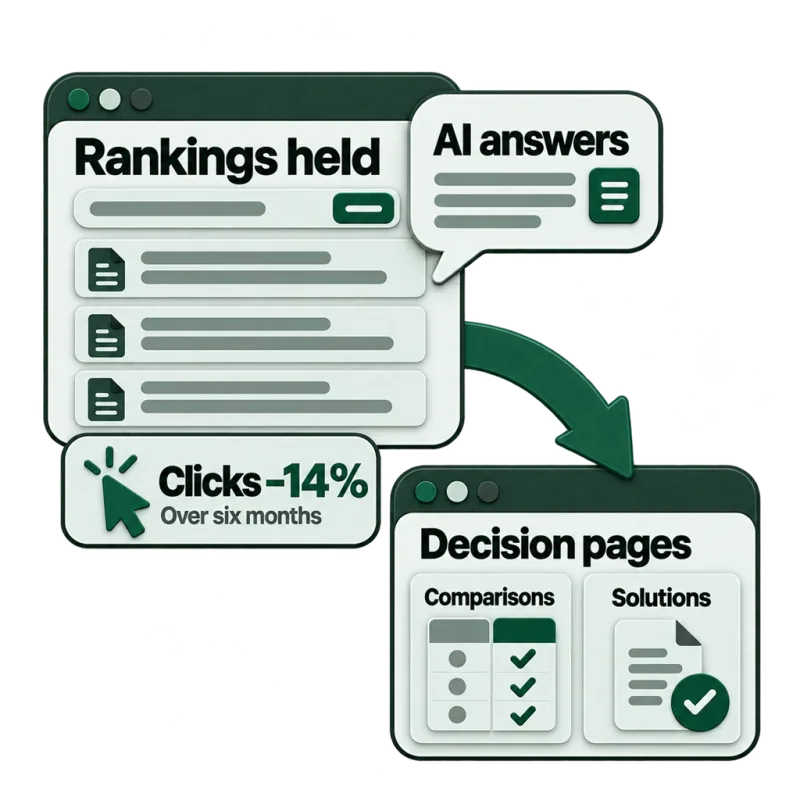
−14%
Organic clicks
Clicks, rankings unchanged
A B2B SaaS case: positions held across the period, clicks dropped 14%. The answer moved into the AI summary.
Case study: losing clicks to AI search
Own measurement · anonymized client project.
Pricing
I charge €50 per hour. Every figure below is hours × €50, so you can see what each budget buys.
Hourly consulting€50 / hour
Example project
B2B website
One website
- 01
B2B SEO audit
Buyers and the buying journey, search demand, commercial pages and content, the technical foundation, links and mentions; a prioritized task list.
€1,000
20 h · one-off
- 02
Competitor research, three to five competitors
Search visibility and content gap, AI answers, offer and positioning, links and mentions; a list of pages to build and sources to get mentioned in.
€600
12 h · one-off
- 03
Monthly work
Page briefs, checking what was implemented, the source fields and the pipeline report in your CRM, monthly reporting.
€600
12 h / month
These are indicative budgets, not fixed prices. The platform, the number of templates, how the site is built and what the audit finds all change the final quote. Content writing and development are priced separately.
No VAT is added to these figures — I’m VAT-exempt under Hungarian law.
When does B2B SEO pay off?
B2B SEO pays off when organic search brings in more from new customers than the consulting, the content and development work, and your team’s time cost together. The audit and the competitor research together cost €1,600. If a new customer is worth €5,000 to you in the first year, one customer from organic search covers that. Because of the sales cycle, the return shows later than the leads do, so compare the cost with what a customer is worth over the whole contract, and with what the same customer costs through ads or outbound. Delay has a price too: while your product and comparison pages don’t show, buyers building a shortlist find someone else.
What the monthly budget covers
Research, strategy, implementation or coordination with your developers, monitoring, meetings and reporting. Reporting time counts in the hours.
You get access to the project management tool, where you can see the priorities, who is responsible, progress and what comes next. Each month starts with agreed priorities and ends with a review of what changed and what the data shows.
Priced separately
Content writing and production, including an external writer if needed.
Outreach and digital PR. The audit includes the backlink analysis and recommendations.
Setting up or repairing measurement. The audit analyzes your existing data; new tracking and integrations are scoped separately.
Development beyond the agreed hours, including external developer fees.
AI search research or monitoring beyond the agreed topics, languages and AI systems.
Before you start
You receive a proposal with the scope, the estimated hours, the audit fee and the monthly budget. It also states whether the first phase includes implementation, when the ongoing work begins, and what your team needs to provide.
There is no lock-in. Any change to the scope or budget is agreed before the extra work starts.
Questions
How much does B2B SEO consulting cost?
I charge €50 an hour. An audit is about 20 hours (€1,000), competitor research about 12 hours (€600), and ongoing work is billed monthly for the hours used, with no lock-in. Content writing and development are separate costs, and I estimate them in the roadmap.
When will SEO show up in our pipeline?
I don’t give a date, because two things I don’t control decide it: how fast the changes get implemented, and how long your sales cycle is. What I do is show the earlier signs in the same report: visibility for commercial searches, visits to product and solution pages, demo and contact requests, then qualified leads. Pipeline and revenue follow at the pace of your sales cycle.
Is SEO worth it when hardly anyone searches for what we sell?
Sometimes it isn’t, and I tell you after the demand check. Low volume alone doesn’t decide it: twenty searches a month for a product with a €30,000 contract can be worth more than thousands of readers on a general guide. I look at searches for the problem, for alternatives, for competitor names and for integrations. If buyers don’t yet know that a solution exists, search can’t be the main channel, and outbound, partners or marketplaces come first.
We rank well in Google. Why doesn’t ChatGPT mention us?
AI assistants build their answers from several sources, not only from your site: lists, review sites, trade publications, forums and comparison pages. A company can rank for its own terms and still be missing from those sources. I check which buyer questions you’re missing from, and which sources the answers cite. Whether you get named after that is up to the assistant, and I don’t promise it.
Can we start with an audit and do the fixes ourselves?
Yes. The audit ends in a prioritized task list, written so that your marketer, writer or developer can work from it. You can run the list yourselves and ask me to check the work, or come back with questions. There is no commitment after the audit.
How can we tell whether an SEO audit or proposal is any good?
A useful audit names specific pages and queries from your own data, puts the tasks in order, and says who does each one and which metric it should move. It starts from what a lead is worth to you. A proposal should state what is delivered each month, who does the work, who owns the accounts and the content, and how the contract can be ended. If it counts keywords, posts or links, ask which pages they serve.
Should we spend on paid search or account-based marketing instead?
They do different jobs. Paid search brings visits right away and stops when the budget stops; it is also a quick way to test which queries bring leads before you build pages for them. Account-based marketing goes after named accounts whether they search or not. SEO reaches buyers who search on their own, including the people on a buying committee your sales team never talks to. Most B2B companies run a mix, and I tell you which queries I’d leave to ads.
Which CRM do you work with?
HubSpot and Salesforce are the most common, and I work in the one you use. I need admin access to add the source fields and build the report; the account and the data stay yours. If your CRM admin prefers to make the changes, I write up what’s needed.
Are comparison and alternatives pages worth building?
When buyers search for “[competitor] alternative” or “[you] vs [competitor]”, yes: someone will answer those searches, and it’s better if your own account is among the answers. The pages work when they’re fair (they say who the other product suits better), specific (features, pricing model, integrations) and kept up to date. I start with the competitors that come up on your sales calls.
Will we work with you directly, or with a team?
With me. I do the audit, the research and the roadmap myself, and I’m the one on the calls. Writing and development are done by your team or your suppliers from my briefs, and I can make changes in the CMS myself where that’s faster.
We’re an agency. Can you review our B2B SEO work for clients?
Yes. I work with agencies as a second pair of eyes: reviewing the research and the strategy, auditing a client’s site, or preparing the measurement setup. I can stay in the background or join client calls, whichever you prefer. The hourly rate is the same.
Traffic without leads, or a proposal you can’t judge?
Send me your website and what counts as a qualified lead for you, and I’ll tell you where I’d start.