Website content strategy
Website content strategy decides which pages a site should create, improve, merge or retire, and in what order, so that each page matches a search intent and the site is found in search and cited in AI answers. I work as an independent content strategy consultant: I set the priorities, write the briefs and work with your team until the pages are live.

When you need a website content strategy
A website content strategy is needed when content exists or is being made, but it isn’t clear what each page delivers or what should come next. These are the situations in which companies most often look for a content strategy consultant:
You publish regularly, and traffic still doesn’t grow. New articles have been going out for months, written by people and with AI, yet one or two pages bring most of the traffic. The volume is rarely the problem: the articles don’t add up to topics, and they don’t each answer one search intent.
Traffic falls year after year. Your old best pages are slowly losing traffic: the topic has aged, a better answer has appeared in the results, or what searchers want has changed. This is content decay, and what to do differs page by page.
You have a team, but no strategy. There is a content manager or a writer, but nobody has decided where to start, what matters more, or what to measure the results against. The work doesn’t stall on the writing. It stalls on the order and the decisions.
Years of content have piled up. There are a hundred pages or more, some outdated, some no longer related to what you sell today. You don’t know what to update, what to merge and what to delete.
AI search is taking the clicks. The page ranks, but an AI Overview answers the question above the result, or AI answers cite your competitors. Leadership is asking what to do about it.
Traffic comes in, but leads don’t. The blog brings visitors, but they don’t get in touch, or a blog post ranks instead of the service page where the form is. That’s a sign the content and the search intent don’t match.
Content audit: what I check
A content audit goes page by page through what each page delivers, which search intent it answers and what its job on the site is. These are the areas, and what I check in each:
Search intent and the results page. Search intent means what someone searching for a phrase actually wants: to learn, to compare or to buy. I check which of your pages answers which intent, and what format the results page expects: a guide, a list, a service page or a video. I also check whether the query has an AI Overview.
Content inventory. A content inventory is every page on the site with its traffic, conversions, main queries and date. It shows what delivers, what is declining and what has never delivered anything.
Cannibalization. Cannibalization is when several pages compete for the same query and Google keeps switching which one it shows. The query-by-page view in Search Console shows where it happens and which page should be the designated one. The fix isn’t always a merge: sometimes it’s enough for the pages to answer different intents. The technical canonical setup is part of technical SEO.
Topic structure. Topic structure shows how pages add up to topics: one broad topic page and the detailed pages around it. I check which topics have demand and competitor content but no good page on your site, which entities you name, and how pages link to each other by topic: with descriptive anchor text, toward the topic page. This information architecture is what builds topical authority, meaning that search engines treat your site as the most complete source on a topic.
Content quality. Google looks at content quality from the reader’s side: who the page is for, what it adds to what is already in the results, and whose experience stands behind it. Information gain is your own data, cases or expert knowledge that readers can’t find elsewhere. Experience, expertise, authoritativeness and trust (E-E-A-T) come from that and from how well known the brand is.
Template- and AI-generated content. Pages generated from templates or with AI, such as pages built from product data or location lists, create many URLs quickly. I check whether they give readers anything or just repeat each other, because mass content that adds little hurts quality and trust at the same time.
Multilingual content. On multilingual sites I check whether the content was translated or actually localized: the search terms, the examples and the currency differ by market. The cost and risk of localization are worth taking on in line with the size of the market. The hreflang setup is part of technical SEO, and choosing markets is part of international SEO consulting.
Existing content: refresh, merge or retire
Managing existing content means deciding page by page whether to refresh, merge or retire it. I make the decision from the audit data:
Refresh when the page ranks or has brought traffic, and the search intent hasn’t changed. Outdated data, examples and structure are replaced, and the URL stays.
Merge when two pages answer the same intent. The better-performing page stays, the other one redirects to it with a 301, and its useful parts move over.
Retire when the page isn’t related to the site’s topic, has no traffic and no links pointing to it. That means a 410 or a 404. If it has links or traffic, it gets a 301 to the closest related page.
A retired URL comes out of the sitemap and the internal links. If you’re worried that rewriting will hurt existing rankings, we start with a few pages and measure the result before extending the change to the rest. After that, the important pages are reviewed regularly, because maintaining content is an ongoing cost, not a one-off job.
Content in AI search
Content in AI search competes paragraph by paragraph: AI Overviews and AI answers cite one clearly bounded part of a page. So on the important pages I check whether each question has its own answer that makes sense on its own, whether there is your own data or experience, whether you name the company, products and services consistently, and whether the structured data matches what is on the page.
If a page ranks but gets no clicks because of an AI Overview, there is little to improve in the answer to an informational question. Clicks come more from content with buying intent: comparisons, prices, “which one is right for me”, because the AI answer is usually not enough to decide on those. Whether AI answers cite the page, and how often, is what generative engine optimization (GEO) measures.
How I work: the content strategy loop
Website content strategy is a repeating loop for me, with seven steps. I look at the same metrics before and after the work, so you can see what each change delivered.
01
Goals, audience and data
The first step is the goal: what the content has to achieve, who it’s for, and what those people ask your sales or support team. This first-party data says more about your audience than any tool.
I collect data from Search Console, analytics, a full crawl (Screaming Frog), and keyword and SERP data (Ahrefs, DataForSEO). Keyword research is a data source here: it shows what there is demand for and which words people search with. A checker I built myself runs through the entities. If consent management means analytics only sees part of your visitors, I account for that. I pay for the tools; their cost is included in the hourly rate.
02
The baseline
The baseline records where we start: impressions, clicks, click-through rate and average position in Search Console, organic sessions and conversions in analytics, and content coverage, meaning how many of the important topics have a good page on your site.
03
Audit
The audit goes page by page through seven areas: search intent and the results page, content inventory, cannibalization, topic structure, content quality, template- and AI-generated content, and multilingual content. It assigns a decision to every page: keep, refresh, merge or retire.
04
Priorities and content roadmap
Three things set the order: how big the impact is, how much work it takes, and whether there is demand for it. That becomes the content roadmap: what comes first (a fix, a merge or a new page), who owns it, and which metric it will show up in. A short strategy summary goes with the roadmap, so the team can see why the order is what it is.
05
Briefs
A brief tells you, page by page, which search intent the page answers, which questions it has to cover, in what structure, which entities to name, where to link, and whose expertise it needs. An expert’s time is the scarcest resource, so the brief says up front what is needed from them. For an existing page, the brief lists the on-page fixes.
06
Publishing and governance
Content works when it’s clear who decides, who approves and at what pace pages go live. I set up the editorial workflow together with your team, and I check what the CMS allows: templates, fields and old technical choices often decide more than the copy does. Before a page goes live, I check that it does what the brief asks.
07
Re-measurement and refresh cycle
Re-measurement happens page by page, not for the site as a whole. For the pages we changed, I look at the same things as in the baseline:
- impressions, clicks and position in Search Console, by query;
- organic sessions and inquiries in analytics, by landing page.
I compare the result in two ways. With the same period a year earlier, so seasonality doesn’t distort it. And with the pages we didn’t touch, so you can see what comes from the change and what comes from the market. If inquiries go into a CRM, I check their source there too. Every quarter you get a page-by-page report: what improved, what didn’t move, and what comes next. I don’t promise timelines. I tell you what we measure and what we compare it against.
Proof
+38%
Google impressions, Oct 2026 vs. Oct 2025
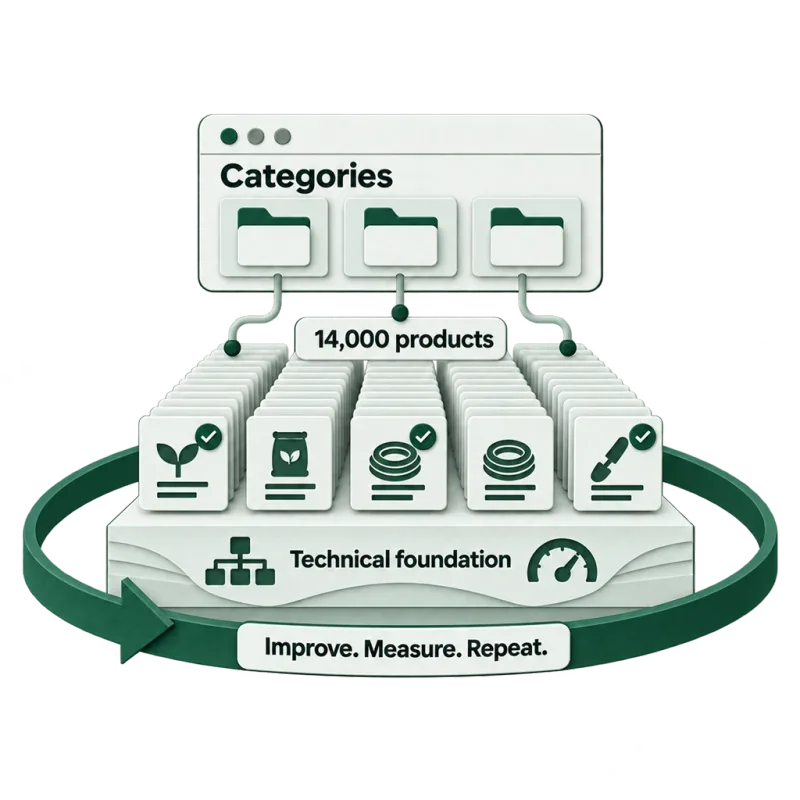
SEO on a catalog of 10,000+ products
A ShopRenter catalog of 10,000+ products, restructured in two-week sprints from March to September. Traffic held during the changes; in October, impressions were 38% above the year before.
Case study: SEO for a large e-commerce catalog
Impressions, Oct 2026 vs. Oct 2025 · Google Search Console
Pricing
I charge €50 per hour. Every figure below is hours × €50, so you can see what each budget buys.
Hourly consulting€50 / hour
Example project
Website
Around 200 pages
- 01
Website content audit
Content inventory, search intent and cannibalization, a decision for every page (refresh, merge or retire), a prioritized list.
€600
12 h · one-off
- 02
Content roadmap and briefs
After the audit. A three-month roadmap and briefs for 10 pages.
€700
14 h · one-off
- 03
Quarterly review
How the important pages perform, what is weakening, what comes next.
€200
4 h / quarter
These are indicative budgets, not fixed prices. The platform, the number of templates, how the site is built and what the audit finds all change the final quote.
No VAT is added to these figures — I’m VAT-exempt under Hungarian law.
When does content strategy pay off?
Content strategy pays off when the refreshed and new pages bring more inquiries than the audit, the roadmap and making the content cost. The audit and the roadmap together cost €1,300. If you earn €1,500 on a new client, one new client already covers that. A well-maintained page can bring visitors for years; an outdated one brings fewer month after month.
Before you start
You receive a proposal with the scope, the estimated hours, the audit fee and the monthly budget. It also states whether the first phase includes implementation, when the ongoing work begins, and what your team needs to provide.
There is no lock-in. Any change to the scope or budget is agreed before the extra work starts.
Questions
Do we need a consultant if we can research keywords and write with AI?
AI gives you keyword lists and copy quickly, but it doesn’t decide which pages the site needs, for which intent, in what order, or what to do with the old ones. I use AI too. My job is the decision: what goes on the site and what doesn’t.
Can you set priorities and direct our existing team?
Yes, that’s a large part of the work. The roadmap says what comes first, and the briefs say, page by page, what needs doing. I work with your team, not instead of it.
How long does it take, and when should we change course?
I don’t promise timelines, because how fast changes are processed differs by page and by topic. I tell you up front what we measure and what signal makes us change course: if the measured pages don’t move after a change, we try a different approach in the next round.
Will it bring leads, or just traffic?
The goal is leads. That’s why the audit also checks which page answers which intent, and whether you have pages for the searches that come right before buying: comparisons, prices, “which one is right for me”. We measure the result in conversions, not only traffic.
Should we fix old content or write new?
It usually makes sense to start from what you have: a refreshed or merged page builds on its existing rankings and links, while a new page starts from zero. A new page is needed when an important intent has no page on your site. We refresh when a page ranks and the intent hasn’t changed; we merge when two pages answer the same intent.
Will rewriting our content hurt the rankings we have?
It can, so we don’t rewrite everything at once. We start with a few pages, measure, and only then go further. On pages that perform well, we’re careful with the parts that rank.
Is content still worth paying for when people search with AI?
AI answers work from content too: they cite search indexes and websites. What changes is the structure and the focus of the content: answers that stand on their own, your own data, and more pages with buying intent. Some informational articles get fewer clicks than they used to.
How is this different from paid ads?
Ads bring traffic for as long as you pay for them. Good content works for years, but it starts slower and needs maintenance. Most companies need both; the organic channel lowers what a new customer costs.
Should we hire in-house or get outside help?
If there is a full-time job’s worth of content work, you need someone in-house. For the strategy, the audit and setting up the workflow, an outside consultant is often enough, and the team can carry on from the roadmap and the briefs.
What does a Google update mean for our content?
An update rearranges what Google considers most useful for a query. If a drop lines up with an update, I look at which pages fell, which intent they answer, and what now ranks above them. There is no guarantee an update won’t affect a page; I tell you what can be done.
How do I know if a content strategist knows their stuff?
Ask which data they start from, how they decide about old pages, and what they measure the results against. If all you get is a topic list and a content calendar, that’s a content plan, not a strategy.
Not sure where to start with your content?
Send me your site’s address, and I’ll tell you which pages to start with.