Organic search growth system
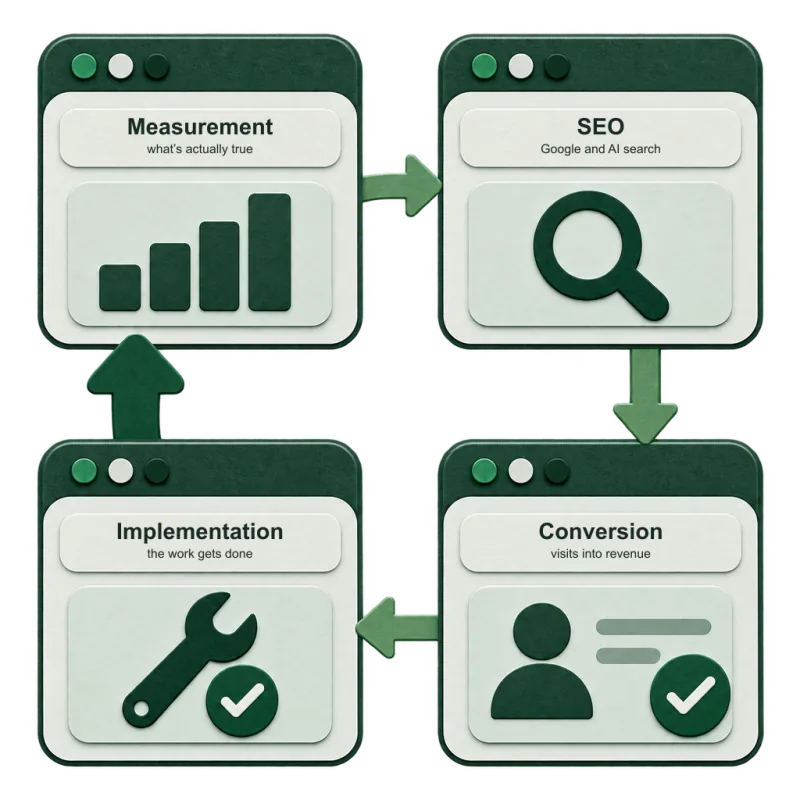
The organic search growth system connects search engine optimization (SEO), web analytics, conversion rate optimization and the implementation of all three into one plan and one queue of work. I run it as one person, with a team of artificial intelligence (AI) agents: I assess where the website stands, say what to start with, and build the changes or see them through with your team.
When you need an organic search growth system
An organic search growth system is needed when a website has several problems at once, and it isn’t clear which matters more. These are the situations in which people most often come to me:
There are several problems at once, and you don’t know where to start. Traffic is low, you don’t trust the numbers, and few visitors become customers.
There are several reports, and none of them shows what brought results. Each team measures its own channel; nobody measures the shared outcome.
There is a separate provider for everything, and nobody looks at the whole. SEO, ads, development and measurement don’t work from one list, so tasks wait on each other.
Traffic grows, revenue doesn’t. Or the other way round: the site is good, and search engines don’t bring the visitors.
You spend more and more on ads for the same result. You want to build traffic from search alongside it.
The audit or the strategy is finished, and it has been sitting since. There is nobody to put it in order and do it.
The four services in the system
The system is made of four services, and each adds something different: the first brings traffic, the second shows what happens to it, the third turns more of it into customers, the fourth builds what the other three ask for.
SEO consulting.
It adds that the website gets found: in Google, in Bing and in the answers of AI search engines, which is the field of generative engine optimization (GEO).
Start here if few visitors come from search, or the ones who come aren’t the ones who become customers.
Web analytics consulting.
It adds that the numbers can be trusted: the web analytics tool, the ad platforms and the store or the customer relationship management system describe the same thing.
Start here if you can’t say which channel brings what.
Conversion rate optimization consulting.
It adds that more of the arriving visitors become customers or leads.
Start here if there is traffic, and the conversion rate of visitors from search is low.
SEO implementation.
It adds that recommendations become shipped, checked changes: either your developer builds them and I run the project, or I build them myself in the content management system and the code.
Start here if the audit already exists and is sitting.
Any of the services can be ordered on its own. The system gives more when at least two run together, because the tasks concern the same website and the same developer time.
Why one plan: where the areas meet
One plan matters because the four areas work on the same website, and much of the loss arises where two of them meet. A shared plan gives four things:
One fix affects several areas. When templates load faster and Core Web Vitals improve, that is good for search and for the buyer. When the two areas work apart, the same job is requested twice, or not at all.
The loss arises between areas. A well-built page brings nothing if it answers a different search intent from the one the visitor arrives with. Two pages made for the same search take the place from each other. And the best traffic is worth little if measurement can’t say what became of it.
One shared yardstick. I look at one chain from impression to revenue: impressions, click-through rate and clicks, average position, sessions, the visits likely to buy or inquire, conversion, the revenue attributed to search. For the same page and the same period, so it shows where the chain breaks, and what the work added on top.
One ranking. Every task sits in one list, by impact and effort, whatever area it comes from. Two recommendations then don’t compete for the same developer hour, and results build on each other: better measurement gives a sharper ranking, a better page turns more traffic into more customers.
The order: which area to start with
The order is the system’s first question, and on most websites the answer follows three phases. After the assessment, the roadmap is built from this:
Measurement and foundations first. I record the baseline, check that measurement shows what is happening, and a technical audit looks at the infrastructure: whether anything keeps search engines from crawling and understanding the site. Until this is in order, the results of the other work don’t show, or never reach the search engines. Fixing the technical faults found belongs here.
Content and authority next. I assess how large the addressable search demand is, where the opportunities are, what is worth writing or reworking, and who links to you. I rank the opportunities, because there are more of them than there is time for.
Conversion and expansion last. Once the right visitors arrive, I work on turning more of them into customers, and on extending the system to new topics or markets.
I depart from the order when the data says otherwise. If traffic is good and conversion is poor, we start with the third phase; if measurement is reliable and the technical base is sound, we skip the first.
Organic search and paid advertising: what to expect from the system
Organic search and paid advertising reach the same visitor in two different ways, and they work well alongside each other, not in place of each other. This is what to expect:
What organic search gives. Traffic doesn’t stop when ad spend stops. What you have built once stays an asset of the company, and the cost of a customer won through organic traffic can fall over time, because the same page keeps bringing visitors. That can lower the cost per customer across the company, above all where a customer stays long and is worth a lot.
What it doesn’t give. It isn’t immediate: time passes between the work and a measurable result, and the payback period differs from one website to the next. Changes made by search engines move rankings, so the rate of growth is uneven. If you need traffic tomorrow, that is what ads are for.
The two together. Data from paid search and social media ads shows which terms and messages bring customers; from that you can tell what is worth building a page for. Where a company works with outbound sales or account-based marketing, content arriving through search helps the person contacted to know the name.
What we measure along the way. Share of search, that is how much of the market’s searches reaches you, your share of visibility against competitors, and whether AI answers mention and cite you.
I don’t give a number for how long payback takes. I say what we measure each month, and what shows it is going the right way.
One person with an AI team: who does the work?
The work is done by one person, with a team of AI agents. This setup decides what you can expect:

Who works. I do, Krisztián Kiss. My team is not made of people: it is AI agents that I have organized into my own processes. They gather and sort the data, prepare the analysis and the task write-ups, run the checks, and work on the code.
What that means for you. More work fits into an hour than one person does alone. You talk to one person who knows the whole website. Every task sits in a shared project management tool, so the work can be followed, checked, and continued by someone else.
Who is responsible. I am. I check every finding and every released change myself before it reaches you. I work with few clients at a time, and I say in advance when my capacity is full.
When you need someone else alongside. If the work takes several people every day, an in-house team or an agency is the fit. A hybrid setup is common: your team or agency carries the daily work, and I take search, measurement and the ranking. What matters then is that it is settled who decides what, and who owns the shared list; you settle the fees of outside specialists with them.
How I work: the steps of the organic search growth system
The organic search growth system works in five steps, and after the fifth the second comes again: the work is a cycle, not a one-off project.
01
Assessment and baseline
The first step is recording the baseline: what Search Console and web analytics show, how the numbers relate to orders and leads, and where the website stands in search engines and in AI answers. Search performance data and the queries show what you are found for today. Everything that happens afterward is measured against this.
02
Shared ranking and plan
The findings of the four areas go into one list, ordered by impact and effort. The roadmap comes from this: what happens first, what it needs from you, and what we expect from it.
03
Implementation
I build the changes myself, or see them through with your team, task by task. For content we settle what is made new, what has to be refreshed, and at what pace; we decide about old content too: it stays, is reworked, is merged, or goes.
04
Measuring back
After every change I look at what happened against the baseline. Where traffic allows, I use a controlled experiment to see whether the change is due to the work: some pages get the change, others don’t. Where it doesn’t, I compare a longer period and track how visibility moves.
05
Regular review
Each month we go through what we measured, what was done, and what changes in the ranking. Each quarter, the plan as a whole: whether we are going the right way, and whether something should be stopped. In between I keep watching the main metrics, and say so when something leaves its usual range.
Proof
+38%
Google impressions, Oct 2026 vs. Oct 2025
SEO on a catalog of 10,000+ products
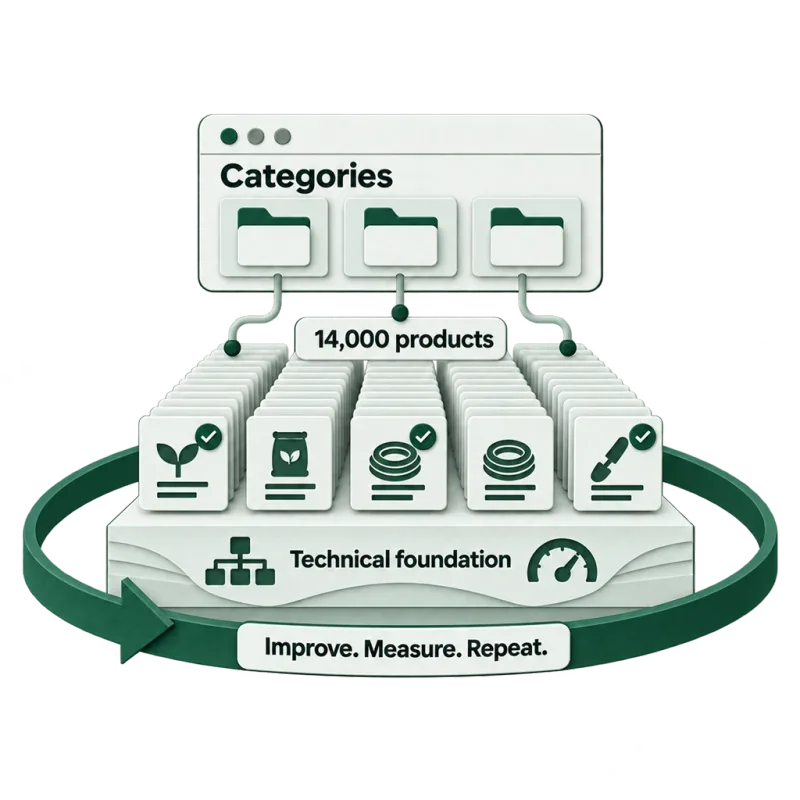
A ShopRenter catalog of 10,000+ products, restructured in two-week sprints from March to September. Traffic held during the changes; in October, impressions were 38% above the year before.
Case study: SEO for a large e-commerce catalog
Impressions, Oct 2026 vs. Oct 2025 · Google Search Console
68%
of new-user demo and sign-up starts are linked to organic search
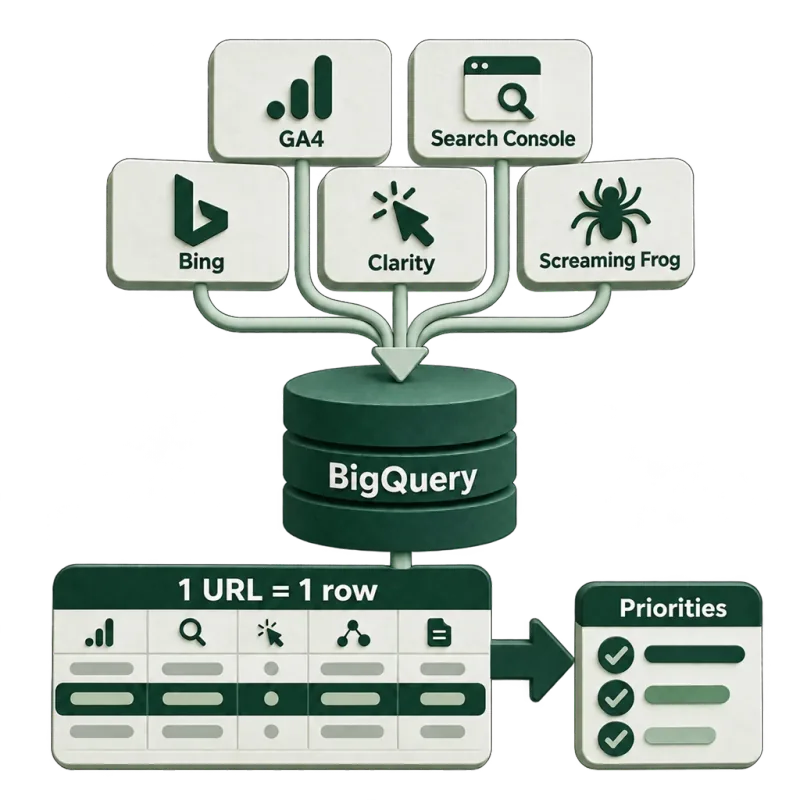
An SEO data warehouse from five sources
Five sources joined by URL in one BigQuery table showed which page to fix first, and how much SEO brings beyond the last click.
Case study: an SEO data warehouse in BigQuery
Own measurement, five sources in BigQuery, 30 days.
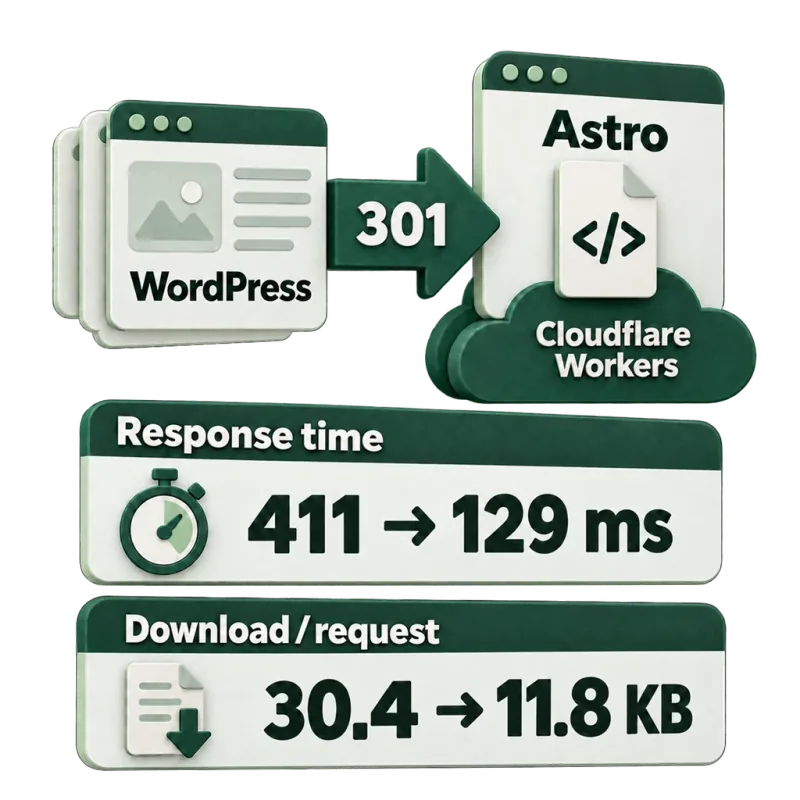
411 → 129 ms
Googlebot response time
WordPress to Astro: what Google saw
kk.coach moved from WordPress to static Astro pages on Cloudflare Workers. The response time Googlebot measured fell from 411 to 129 ms, and 37 of the 40 sitemap URLs appeared in search within 24 days.
Case study: WordPress to Astro migration
Own measurement · kk.coach · Google Search Console
Pricing
The hourly rate is €50. The hours of a full engagement are the sum of the hours of the four services: ordered together it is the same as separately, only it runs in one plan and one list. What follows are examples for one website each, not a price list; I give you your own hours in writing after a short call.
Example: a service company’s website, about 50 pages
- 01
Full audit and plan
SEO audit and strategy 16 hours, measurement audit and plan 6 hours, conversion audit and research 8 hours, shared backlog 8 hours.
€1,900
38 hours · one-off
- 02
Ongoing work
SEO 12 hours, monitoring measurement 2 hours, conversion 4 hours, project management and checking 6 hours.
€1,200
24 hours / month
Example: an online store, about 5,000 products
- 01
Full audit and plan
SEO audit and strategy 36 hours, measurement audit and plan 12 hours, conversion audit and research 16 hours, shared backlog 10 hours.
€3,700
74 hours · one-off
- 02
Ongoing work
SEO 40 hours, monitoring measurement 4 hours, conversion 8 hours, project management and checking 6 hours.
€2,900
58 hours / month
Setting up measurement and building the changes are separate items, as in the examples on the service pages. On top of the work it is worth planning for these costs, which you pay to the provider: subscriptions for search and analysis software, researching and writing content, the work of getting covered in trade press and on other websites, development and infrastructure. If the budget is tight, we look together at what would be given up if the money went elsewhere.
These are indicative budgets, not fixed prices. The platform, the number of templates, how the site is built and what the audit finds all change the final quote.
No VAT is added to these figures — I’m VAT-exempt under Hungarian law.
What the monthly budget covers
Research, strategy, implementation or coordination with your developers, monitoring, meetings and reporting. Reporting time counts in the hours.
You get access to the project management tool, where you can see the priorities, who is responsible, progress and what comes next. Each month starts with agreed priorities and ends with a review of what changed and what the data shows.
Priced separately
Content writing and production, including an external writer if needed.
Outreach and digital PR. The audit includes the backlink analysis and recommendations.
Setting up or repairing measurement. The audit analyzes your existing data; new tracking and integrations are scoped separately.
Development beyond the agreed hours, including external developer fees.
AI search research or monitoring beyond the agreed topics, languages and AI systems.
Before you start
You receive a proposal with the scope, the estimated hours, the audit fee and the monthly budget. It also states whether the first phase includes implementation, when the ongoing work begins, and what your team needs to provide.
There is no lock-in. Any change to the scope or budget is agreed before the extra work starts.
Questions
Can I hire you for just one area?
Yes. All four services can be ordered on their own, and many engagements start with one. If it turns out along the way that the problem lies elsewhere, I say so, and you decide whether to widen the work.
What if we already work with an agency or an in-house team?
I can work alongside them. I take the part they don’t cover, and the shared list shows who does what. You don’t have to choose between them and me.
Why one person and not a team?
Because you talk to one person who knows the whole website, and nothing is lost in handoffs. What would be too much for one person is carried by my AI agents. If the work takes several people being present every day, I say so, and that calls for an in-house team or an agency.
What does it mean that you work with an AI team?
That part of the work is done by AI agents that I direct: they gather data, prepare analysis, write task descriptions, run checks. They are not people, and they don’t decide. What you receive I have reviewed, and I am responsible for it.
Which area should we start with on a small budget?
The one causing the biggest loss. If measurement is unreliable, that one, because otherwise the results of the other work don’t show either. If measurement is in order, a short assessment shows whether traffic or conversion is the narrower point. You don’t have to start all four at once.
When do results show?
I don’t give a time for this, because it depends on the website, the market, and how quickly changes get released. I say what we measure along the way: first whether search engines crawl and index what they should, then impressions and clicks, finally conversion and revenue.
Organic search or ads: which should we spend on?
Most companies need both, in different proportions. Ads bring traffic at once, and stop when the spend stops. Organic search builds more slowly, and stays. If you are just starting, ad data is the quickest way to learn what is worth building a page for.
What happens when Google or the AI search engines change something?
Rankings move; that is part of the work. I work so that the website complies with the search engines’ guidelines, because breaking them can bring a penalty or removal from the results. After a change I look at what it affected and adjust the ranking of tasks. European privacy and digital rules affect measurement, mainly through how consent is handled; I do the setup, and your lawyer decides on compliance.
Hand-written pages or pages generated from data: which is right for us?
It depends on what people search for. Where there are many similar searches on the same pattern, product and city pairs for example, pages built from data with a template work, if they give real information; the same holds when the product itself creates the pages. Where the question needs an expert answer, hand-written content does. On many websites the two run together. If accumulated technical debt in the current system means neither can be built at a reasonable cost, the assessment will show it.
Next step
Not sure which area to start with?
Tell me what is wrong with the website and what you have tried so far. I’ll tell you what I would start with, and why.