SEO consulting for B2B and ecommerce
Moves the revenue, not the rankings.
I work with B2B teams and ecommerce operations that have traffic but lack pipeline — and need someone who connects SEO to revenue, not just rankings. Hands-on implementation included.
- Technical SEO
- Intent mapping
- Information architecture
- Ecommerce SEO
- Trust signals
- Site speed
Does this sound familiar?
Five situations that bring people here.
Sessions are up. Revenue isn’t.
We got an audit. Nothing got implemented.
We publish content. It doesn’t bring the right people.
Nothing looks broken. It still isn’t working.
We can’t prove what organic actually contributes.
Why SEO fails
The SEO got done. The revenue question never got asked.
I usually get called in after someone else has already done SEO. The work was normally real — keywords targeted, content produced, links built — and often competent. What was missing was the question underneath it: would any of this move the pipeline, and how would we know?
These six are what I keep finding.
Pattern 01
The audit nobody opened
A sixty-page PDF, delivered and paid for. When I ask to see it, someone finds it in an old email thread. Nothing in it was wrong — it just never became work, because nobody costed the items or put them in an order.
Pattern 02
Traffic that was never going to buy
The chart goes up and the pipeline doesn’t move. Nearly always the same cause: the pages that rank answer questions people ask long before they’re buying, and the page that would answer a buying question doesn’t exist yet.
Pattern 03
Content written to a volume target
Someone picked keywords by search volume and wrote to them. The articles rank. They bring people who are learning, not choosing — and now a content budget is being defended with traffic numbers.
Pattern 04
The slow leak nobody sees
Pages indexed that nobody should see, redirect chains left from an old migration, a site that feels slow on a phone. No error message anywhere. The pages you care about just lose ground month after month, and it gets blamed on competitors.
Symptom 05
No attribution, no defense
SEO runs for a year. Nobody can say what it brought. At the budget review organic gets cut — not because it failed, but because it was the only channel that couldn’t produce a number.
Symptom 06
Paid covering for organic
Ad spend rises every quarter because organic never became a channel that compounds. CAC climbs, margin erodes, and the fix keeps getting postponed because paid still works — until it doesn’t.
Intent mapping
Every search is the top of a funnel.
The engine gets them in; the site decides what happens next.
Fewer people at every stage.
The SEO system
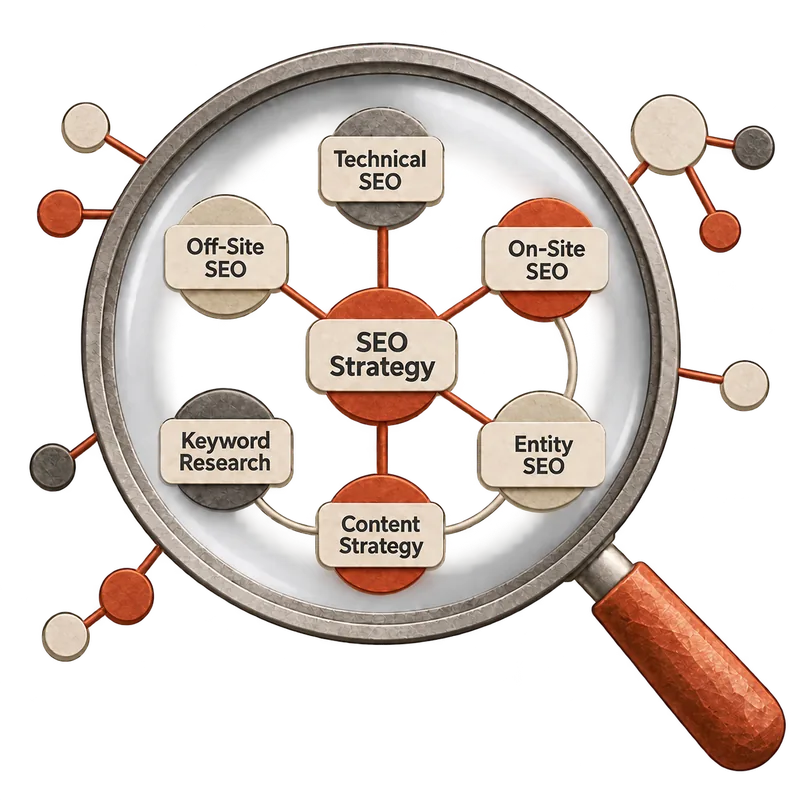
Five pillars. One coherent system.
- Pillar 01
Technical SEO
Stability before scale. Authority cannot compound on an unstable technical foundation.
- Indexing logic — which of your pages Google keeps, and which it should not
- URL structure and canonicals — which version of a page counts as the real one
- Core Web Vitals (LCP, CLS, INP) — how fast the page actually feels on a phone
- Structured data — the machine-readable summary of what a page is about
- Redirect chain cleanup
- Mobile and rendering integrity
- Pillar 02
Information architecture
How the site is organized, and where authority flows. Most sites distribute it randomly.
- Topic cluster design
- Decision-layered page hierarchy
- Internal link architecture
- Authority redistribution — sending internal links to the pages that earn money
- Faceted navigation — the filter pages a shop generates, and which should exist at all
- Silo vs. mesh structure decisions
- Pillar 03
Intent and content strategy
Content aligned to decision stages — not keyword volume targets.
- Intent mapping — matching pages to what people are actually trying to do
- Content gap analysis vs. competitors
- Business-relevant query prioritization
- Conversion-aligned page briefs
- Existing content restructuring
- AI-assisted content modeling
- Pillar 04
E-E-A-T and trust signals
Authority is not declared. It is structured — and E-E-A-T is the shorthand for whether Google and AI systems can tell who is behind this, and why they would trust it.
- Author entity clarity
- Evidence and case study layer
- Thematic depth over volume
- Cross-referenced internal structure
- Trust signal placement
- GEO-compatible knowledge architecture — so AI systems can cite you correctly
- Pillar 05
Digital authority
Link building
Authority that comes from outside the site. Most of it is earned by having something worth citing — not by buying placements.
- Link gap analysis — which sites link to your competitors and not to you
- Target selection: the publications and directories that actually matter in your category
- Digital PR angles — what about the business is genuinely worth writing about
- Unlinked mention audit — where you’re already named without a link
- Destination planning: which pages should be earning links, and which are wasting them
- Measurement against referring domains and pipeline, not against a vendor score
Use cases
The same system. Three different contexts.
The five pillars apply universally. What changes is where the highest leverage is — and what pipeline looks like in your context.
Ecommerce
Traffic exists. Category pages don’t convert.
The typical ecommerce SEO problem isn’t ranking — it’s that the pages which rank aren’t built for purchasing decisions. Category structure, intent alignment, and filter URL logic are where revenue is won or lost.
- Category page intent and structure
- Faceted navigation — the filter pages, and which of them should be indexed
- Product structured data — the summary that makes a rich result possible
- Core Web Vitals — how fast the page feels, and how that tracks with purchase rate
- Internal link flow from content to category
If filters and parameters have multiplied your URLs past ten thousand, crawling becomes a real constraint. Below that it usually isn’t — and anyone telling you otherwise is selling something.
B2B lead generation
Organic traffic exists. Decision-makers don’t arrive.
B2B organic fails when content is built for awareness instead of evaluation. Decision-makers search with specific intent — comparing options, assessing risk, validating providers. SEO must be present at those moments, not just at the top of the funnel.
- Intent mapping across the buyer journey — which page answers which decision
- Service and solution page architecture
- Comparison and alternative content
- Thought leadership with the trust signals Google and AI systems read
- Pipeline attribution — organic to lead quality
Programmatic SEO
Large catalog. Manual page creation doesn’t scale.
When you have hundreds or thousands of URL-level opportunities — locations, products, categories, attributes — programmatic SEO systematizes what would otherwise be manual. The challenge is avoiding thin content penalties while achieving real ranking at scale.
- Template architecture and content differentiation
- Data source structuring for page generation
- Internal link logic for large URL sets
- Quality threshold design — index vs. noindex decisions
Consultant vs agency
The question most people ask before making a decision.
Neither is universally better. The right choice depends on what’s actually limiting your growth — and what level of ownership you need.
SEO agency
Structured capacity, distributed ownership
An agency gives you a team — but often a fragmented one. Account manager, SEO specialist, content writer, and developer rarely share context. Strategy and execution are separated by process layers.
- Works well when you need volume and have internal coordination capacity
- Reporting is structured but often disconnected from business outcomes
- Implementation speed depends on internal handoffs
- Strategy and implementation owner are rarely the same person
- Business context is often lost between layers
Direct ownership, end-to-end accountability
One person holds the full picture
Business context, technical state, content architecture, and conversion alignment. Strategy and implementation are not separated — they are the same decision loop.
- Works best when you need someone who thinks in outcomes, not tasks
- Direct implementation in WordPress / WooCommerce — no handoff gap
- Regular, visible output — in a rhythm that fits your team
- Revenue and pipeline are the KPI — not ranking positions
- AI-accelerated: faster audit cycles, better QA, more iteration
When a consultant is not the right choice: if you need a large content production team, multi-market simultaneous rollout, or a dedicated account manager for internal stakeholder reporting — a larger agency structure is likely the better fit. I’ll tell you this upfront.
How I approach SEO
An audit that ends in shipped work, not a document.
01
Baseline and search performance audit
Current ranking volatility, technical health, index coverage, page speed, and conversion mapping. Where does authority leak? Which pages underperform relative to their potential?
Tools: Google Search Console · Screaming Frog · GA4 · Semrush · Bing Webmaster Tools
02
Decision-level intent mapping
Identify high-impact intent clusters. Model decision stages. Align existing content to revenue relevance. Gap analysis against competitors on decision-stage queries.
03
Structural refinement
Architecture improvements, internal link rebalancing, authority redistribution to priority pages, technical cleanup. Foundation before content.
Tools: WordPress · WooCommerce · Schema markup
04
Conversion alignment
Landing page structure refinement, messaging clarity, UX adjustments, decision-stage CTA hierarchy. SEO and UX aligned — not operating independently.
05
Implementation and monitoring
Direct implementation or structured project management. Ranking shifts, traffic quality, conversion impact, and revenue correlation tracked on every cycle.
Tools: Jira · Trello · Asana · Looker Studio · GSC
What you get first
A baseline you can check, and a plan you could hand to someone else
A technical and intent baseline, frozen before anything changes, and a priced work plan ordered by effect — with the method behind every number. It’s worth the money even if you stop there and take it elsewhere.
What it doesn’t include is a promise about when the first fix lands. That depends on what the audit finds and how quickly changes get approved.
Honest expectation
Four to eight weeks, then three to six months
Technical fixes and structural improvements show impact within 4–8 weeks. Authority and intent alignment compound over 3–6 months. Every engagement starts with a baseline audit so expectations are evidence-based, not guesswork.
SEO + GEO together
One foundation, two surfaces
Strong SEO architecture is the foundation for GEO — generative AI visibility. Entity clarity, structured knowledge, and E-E-A-T signals serve both. Building one strengthens the other.
Evidence
Not promises. Evidence.
The live page this replaced argued for measurement without carrying a single measured number. These are mine, with the method published.
r = −0.81
Page speed and purchase behavior
Page speed and purchase behavior, measured across one ecommerce dataset. Not a correlation someone quoted — one I ran, with the method published.
Own measurement — one ecommerce dataset.
−14%
Clicks, rankings unchanged
A B2B SaaS case: positions held across the period, clicks dropped 14%. The answer moved into the AI summary.
Own measurement · anonymized client project.
475 → 600+
Flat for four months, then a third higher
A 14,000-product catalog reworked over six months. The line did nothing until the fourth month — which is what continuous work looks like before it lands.
Own measurement · anonymized client project.
Tools and AI-first approach
AI doesn’t replace judgment. It accelerates it.
Most SEO work is pattern recognition — finding crawl issues, spotting intent gaps, detecting authority leaks, identifying conversion friction. AI is significantly faster at this than manual analysis.
I use AI throughout the SEO workflow: to accelerate audits, model intent clusters, generate structured content briefs, and run quality assurance across large page sets. What would take days takes hours.
The business interpretation — what to prioritize, what to fix first, what trade-offs to make — remains human. AI provides leverage. Structure provides control. Business logic provides direction.
Audit acceleration
Crawl analysis, log file interpretation, and intent gap detection at scale — in a fraction of the manual time.
Content and intent modeling
Topic cluster mapping, decision-stage query classification, and content brief generation aligned to business intent.
Quality assurance
Consistent checks across large page sets — structured data validation, internal link coverage, E-E-A-T signal review.
Anomaly detection
Ranking drops, traffic shifts, and crawl regressions flagged early — before they compound into larger problems.
Crawl and technical: Screaming Frog · Search Console · Bing Webmaster Tools · PageSpeed Insights
Research and authority: Ahrefs · Semrush · DataForSEO
Behavior and UX: Microsoft Clarity · Hotjar · GA4
Data and reporting: BigQuery · Looker Studio · GA4
AI layer: Claude · ChatGPT · Gemini
Pricing model
What it costs.
I charge €50 per hour. Every figure below is hours × €50, so you can see what each budget buys.
Hourly consulting€50 / hour
Two example projects
B2B website
Around 500 pages
Ongoing engagement
- 01
Initial audit & strategy
Technical health, search performance and how well the main pages support buying.
€1,200
24 h · one-off
- 02
Ongoing work
Content strategy, page briefs, SEO review and agreed technical fixes.
€1,500
30 h / month
or
Standalone audit
Audit & handover
Full investigation and handover
€2,000
40 h · one-off
Webshop
Around 5,000 products
Ongoing engagement
- 01
Initial audit & strategy
Technical health, indexing, category structure and templates.
€1,800
36 h · one-off
- 02
Ongoing work
Category hubs and product groups in batches, monitored between them.
€2,000
40 h / month
or
Standalone audit
Audit & handover
Full investigation and handover
€3,000
60 h · one-off
These are indicative budgets, not fixed prices. Languages, markets, the platform, the data available and the depth of research all change the final quote.
No VAT is added to these figures — I’m VAT-exempt under Hungarian law.
Why is the audit lower with ongoing work?
An audit on its own has to work without me. It covers the full agreed investigation and the recommendations, and ends with a handover your team can work from.
As the start of ongoing work, the audit sets the baseline and the technical priorities, and finds the first improvements. Detailed research on individual topics, categories and product groups continues within the monthly hours. That is why it costs less upfront. The proposal states what is examined now and what comes later.
What the audit covers
The audit starts with a full crawl of the site, a technical and on-page review, and a review of your backlink profile. I also analyze the data you already have in Google Analytics, Search Console, Bing Webmaster Tools and Clarity.
Keyword, search intent and AI search research show how well your landing pages, content and site structure match what your buyers search for. You get a written strategy and a prioritized work plan, with the estimated effort and who is responsible for each task.
B2B website: from the audit to a content plan
For a website with around 500 pages, the audit examines technical health, search performance, and how well the main pages support the buying process.
The ongoing work builds the content strategy: which service pages need work, which buyer questions have no answer yet, and which topics are worth investing in. It includes research, page briefs, SEO review and the agreed technical fixes.
Your team can write the content, or I can bring in an external writer. Writing and production are priced separately.
Webshop: improving the catalog in batches
For a webshop with around 5,000 products, the audit focuses on technical health, indexing, category structure, templates and the first improvements. The crawl covers the whole site; the manual review focuses on representative pages and important exceptions.
The ongoing work develops selected category hubs and product groups in batches. I monitor the pages that changed and use what they show to decide the next batch. This makes each change easier to assess and limits how much of the catalog changes at once.
The monthly plan names the areas that get attention. It does not mean reviewing or rewriting every product by hand.
What the monthly budget covers
Research, strategy, implementation or coordination with your developers, monitoring, meetings and reporting. Reporting time counts in the hours.
You get access to the project management tool, where you can see the priorities, who is responsible, progress and what comes next. Each month starts with agreed priorities and ends with a review of what changed and what the data shows.
Priced separately
Content writing and production, including an external writer if needed.
Outreach and digital PR. The audit includes the backlink analysis and recommendations.
Setting up or repairing measurement. The audit analyzes your existing data; new tracking and integrations are scoped separately.
Development beyond the agreed hours, including external developer fees.
AI search research or monitoring beyond the agreed topics, languages and AI systems.
Before you start
You receive a proposal with the scope, the estimated hours, the audit fee and the monthly budget. It also states whether the first phase includes implementation, when the ongoing work begins, and what your team needs to provide.
There is no lock-in. Any change to the scope or budget is agreed before the extra work starts.
Common questions
What people ask before starting an SEO engagement.
How is this different from a standard SEO agency?
A standard SEO agency delivers tasks — reports, keyword lists, backlinks, content briefs. This is a decision-support system. The difference is accountability: I optimize for pipeline and revenue impact, not ranking positions. Every sprint is evaluated on business outcomes, not activity volume.
I also implement directly — WordPress and WooCommerce, or a new site on Astro and Cloudflare — so there is no gap between strategy and execution.
How long before SEO produces measurable results?
Technical fixes and structural improvements can show impact within 4–8 weeks. Intent-aligned content and authority building compounds over 3–6 months. The first month focuses on highest-leverage quick wins while building the structural foundation for compounding returns.
The honest answer is: it depends on the current state. That is why every engagement starts with a baseline audit — to set realistic, evidence-backed expectations before work begins.
Do I need SEO if I’m already running paid ads?
Paid acquisition and organic are not alternatives — they serve different functions. Paid provides immediate, controllable demand. Organic compounds over time and builds an asset that doesn’t stop working when the budget stops.
The most common pattern is: paid works now, but CAC keeps rising because organic never became reliable. SEO fixes the structural dependency on paid.
What is the connection between SEO and GEO (AI visibility)?
SEO ensures you rank when someone searches explicitly. GEO ensures your brand is referenced when someone asks an AI system for a recommendation or explanation. They share a foundation: entity clarity, structured knowledge architecture, and E-E-A-T signals. Strong SEO makes GEO more effective — and GEO extends the reach of SEO authority into generative AI systems.
They are not alternatives. They are sequential layers of organic visibility.
Will you write content, or only structure it?
My primary role is content strategy, intent mapping, and structural briefs — defining what to create, why, and how it fits the decision architecture. AI-assisted drafts are part of the workflow for speed.
Final editorial quality and E-E-A-T signals require human judgment and subject-matter depth. For high-volume content production, I work with external writers within the defined structure.
Related areas
SEO is the intent engine. These are the layers around it.
SEO is one layer of a system that only compounds when the others hold.
Technical SEO
The layer under this one: index, rendering, speed and structured data — where the crawl and Core Web Vitals work actually happens.
Explore technical SEOMeasurement and data architecture
Attribution clarity and decision-level KPIs that make SEO impact visible and defensible.
Explore measurementGEO — AI visibility
Entity architecture and knowledge graph structuring for citation in generative AI systems.
Explore GEOUX and conversion
Decision architecture and friction removal that turns measured traffic into measurable revenue.
Explore UXExecution
The operating model that turns measurement insights into shipped improvements.
Explore executionNext step
If a previous SEO engagement didn’t move the pipeline, let’s find out why.
Share your website and your primary growth objective. I’ll outline where your SEO system is structurally limiting performance — and what the highest-leverage starting point looks like. No pitch. Just a clear read of the situation.