This number takes weeks to move. Measuring it before anything changes is what makes the next measurement mean something.
Overview
Generative engine optimization consulting
Getting recommended when someone asks an AI instead of searching.
Your rankings can be fine and your traffic still falls — because the answer arrived without anyone needing your page. This is the work of becoming the source that answer is built from.
Also called AI SEO, AEO, or LLM SEO. Same problem, four names.
Problem
You’ve probably already checked
You asked ChatGPT who does what you do, and it named three companies that weren’t you.
Nothing broke. Your rankings didn’t move, your site didn’t go down, no penalty arrived. The answer simply got assembled from other people’s pages.
What this is
What GEO actually is
The definition · four names · how it differs from search · where they come apart
The definition
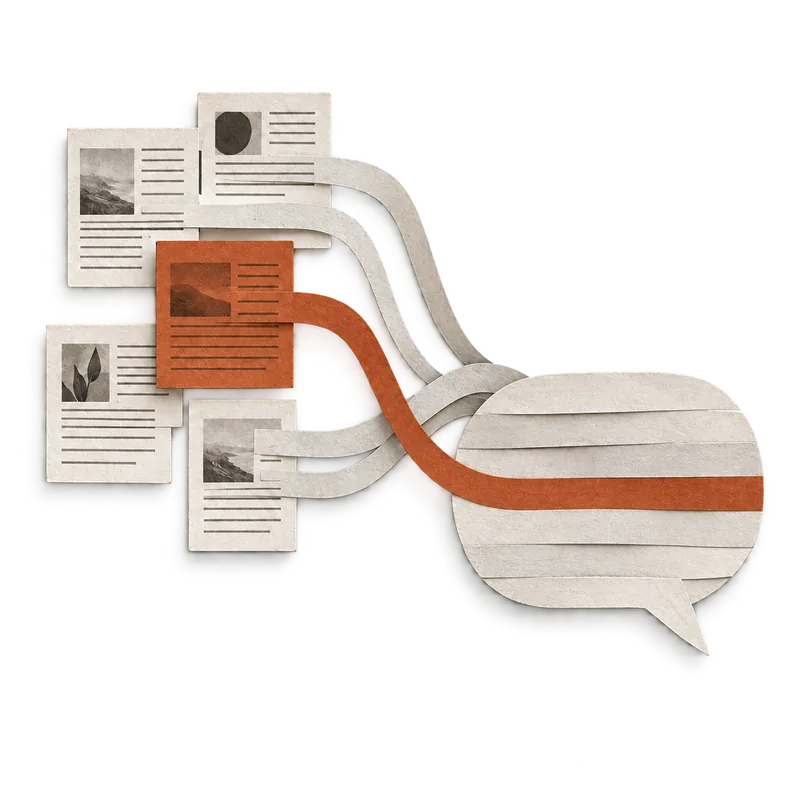
Generative engine optimization is the work of becoming a source that AI systems cite when they answer, rather than a result they list.
That’s the whole idea. Everything else is mechanics.
Four names, one thing
The market hasn’t settled on what to call this. You’ll see:
| Name | Also seen as |
|---|---|
| GEO | generative engine optimization |
| AEO | answer engine optimization |
| AI SEO | — |
| LLM SEO | AI search optimization, AI visibility |
They describe the same work. I use GEO because it’s the oldest and most searched, but if your team calls it AI SEO, nothing changes.
Is it different from SEO?
Google says it’s the same discipline. Plenty of practitioners say it isn’t. Both positions are self-serving, so here’s a measurable answer instead.
Same process. Different scoring.
| Step | Search scores you on | AI scores you on |
|---|---|---|
| Research | what people type | how the question gets broken apart |
| Strategy | topic coverage | whether your entity is unambiguous |
| Content | can it rank | can it be extracted |
| Technical | can it be crawled | can it be parsed and resolved |
| Off-site | links | mentions — a link isn’t required |
| Result | position, clicks | cited or not |
The work rhymes. The failure modes don’t.
Where they come apart
The clearest split is in the technical layer.
Structured data isn’t a ranking factor — Google has been explicit about that for years. A site with broken structured data can rank perfectly well.
But it’s where a machine works out who you are — and that isn’t only structured data: the text itself, the links, and how consistently you’re named elsewhere all feed into whether a system recognizes you as one thing. If a machine can’t parse who you are, it can’t recommend you. Same technical state, two completely different consequences: search shrugs, AI can’t see you at all.
How it works
How the work runs
Five steps, same as the search side. What changes is what each one measures.
Research — how the question gets broken apart
An AI doesn’t match your page to a query. It decomposes the question into sub-questions, answers each, and assembles. So the unit of work isn’t a keyword — it’s the set of sub-questions your category generates.
Strategy — making your entity unambiguous
Machines need to resolve your entity — who you are, as a machine can tell it — before they can recommend you. That means one consistent identity across your site, and enough external corroboration to be sure it’s the same one. Most sites fail here without knowing: multiple conflicting identifiers, no external anchors, key pages unreachable.
Content — written to be extracted
Definitions, comparisons, numbered steps, claims with numbers attached. Not because those formats are better writing, but because they survive being lifted out of context. Prose that only makes sense in sequence tends not to get quoted.
Technical — parseable and resolvable
Structured data that’s actually valid. Consistent identifiers. Content that renders without JavaScript, because not every crawler executes it. This is where my own site failed, and where most sites do.
Off-site — mentions, not links
This is the part that surprises people. A generative system doesn’t need a link to know about you — it needs to have encountered you. Being named in a comparison, a roundup, a discussion counts, even with no link attached. The link-building playbook transfers less than you’d expect.
The systems
They don’t agree with each other.
I put the same buyer’s question to ChatGPT and Gemini — then the same question as a bare keyword. They cited different sources through different mechanisms, and one of them didn’t look at the web at all until it was asked the way a buyer asks.
ChatGPT — searches when you ask like a buyer, not when you type a keyword.
“AI SEO services”, “GEO agency”, “generative engine optimization services” — not one of them produced a single named provider. It answered from memory, or searched only to settle what the phrase meant and cited Google’s and Bing’s own documentation. The natural-language question — I run a B2B SaaS company, who should I hire? — triggered twelve sub-queries, eight of them scoped to specific sites, and it cited providers' own pages.
Gemini — searches every time, and cites the middlemen.
Two or three broad sub-queries, every time, across the open web. It cited comparison articles and third-party roundups — not the providers' own sites. Getting into Gemini’s answer means being in someone else’s list.
Optimize for one and you’re invisible in the other.
Both named individual consultants, not only companies. That’s the direct advantage a single-person practice has here, and the reason this site has a person page and not just a services page.
A provider page gets you into ChatGPT’s answer — but only if the buyer asks in sentences. A mention in someone else’s comparison gets you into Gemini’s. That’s why the baseline runs on several systems, and why “are we cited?” has no single answer.
Google’s AI answers and Claude are in the baseline from now on. I have findings for two systems; I’ll publish what the other two do once there’s enough data to say something that holds.
Own measurement · 30 August 2026 · gpt-5.4 and gemini-3.5-flash via DataForSEO, frozen prompt.
The audit
The audit
An AI citation baseline.
Twenty to forty questions a buyer in your category would actually ask, run across ChatGPT, Google’s AI answers, Gemini and Claude. I record whether you’re cited, and when you’re not, who is instead.
You get the query set, the results, and the competitive picture — who the AI systems currently treat as authoritative in your space.
Why this first
The query set is frozen and versioned, so it can be re-run identically later. Changing one word changes the result — I learned that on my own measurements.
Check yours in two minutes: ask ChatGPT, Gemini and Google who the providers are in your category. Note who gets named. If it isn’t you, note who it is — that’s your actual competitive set, and it’s often not the one you’d list.
The case against me
If you’re looking for an AI SEO agency
Reasonable — it’s the obvious search. Here’s the case against, honestly.
An agency puts a team on it: someone who scopes, someone who writes, someone who reports. GEO work is unusually sensitive to that split, because the technical layer, the content layer and the entity layer have to agree with each other. When three people own three layers, they drift, and the drift is invisible until a machine can’t resolve who you are.
There’s also this: nobody has proven what reliably works yet. Recent systematic reviews of the GEO literature report wide variability across platforms and across repeat runs, and no strong evidence that any single technique produces stable, lasting improvement. Anyone selling guaranteed AI citations is selling something they can’t deliver.
What I offer instead is measurement. I’ll tell you what moved, what didn’t, and what I can’t attribute. That’s a smaller promise, and it’s the honest one.
Pricing model
What it costs.
I charge €50 per hour. Every figure below is hours × €50, so you can see what each budget buys.
Hourly consulting€50 / hour
Two example projects
B2B website
Around 500 pages
Ongoing engagement
- 01
AI baseline & diagnosis
30 buyer questions, asked repeatedly in four AI systems, and what stands between you and the answers.
€600
12 h · one-off
- 02
Ongoing work
Agreed fixes on the site and beyond it, with the measurement repeated.
€800
16 h / month
or
Standalone baseline
Baseline & handover
Measurement, diagnosis and a fix list your team can work from
€900
18 h · one-off
Webshop
Around 5,000 products
Ongoing engagement
- 01
AI baseline & diagnosis
40 questions across categories and buying situations, in four AI systems.
€800
16 h · one-off
- 02
Ongoing work
Category and product information made clear for AI answers, measured again.
€1,200
24 h / month
or
Standalone baseline
Baseline & handover
Measurement, diagnosis and a fix list your team can work from
€1,200
24 h · one-off
These are indicative budgets, not fixed prices. The number of questions, languages, markets and AI systems all change the final quote. A few trial questions for your category are free, as part of the first conversation.
No VAT is added to these figures — I’m VAT-exempt under Hungarian law.
Why is the baseline lower with ongoing work?
A baseline on its own has to work without me. It covers the measurement, what it shows, and a fix list written so your team can act on it.
As the start of ongoing work, the baseline sets the starting point and the first priorities. The detailed work continues within the monthly hours, and the measurement is repeated as the fixes go live. That is why it costs less upfront.
What the baseline covers
I put together the questions your buyers ask AI assistants and ask each one repeatedly in four AI systems, because the answers change from one run to the next. For each question I record whether you are mentioned, recommended or described accurately, whether your own site is cited, and who else appears.
The diagnosis looks at why: what the systems can find about you on your site and elsewhere, and what is missing or unclear. You get a written summary and a prioritized list of fixes.
B2B website: following the buying process
For a B2B website with around 500 pages, the questions follow the buying process: how buyers describe the problem, which solutions they compare, and which providers they ask about.
The ongoing work covers the agreed fixes: clearer service and comparison pages, content that answers the questions buyers actually ask, and your presence on the sites AI systems draw on. The measurement is repeated on the same questions, so the results can be compared.
AI answers also change without any change on your side, so not every shift can be tied to a single fix.
Webshop: categories and buying situations
For a webshop with around 5,000 products, the questions cover categories and buying situations rather than single products: which product fits a need, which brand to choose, where to buy.
The ongoing work makes category and product information clear and consistent: descriptions, specifications, and the pages that compare options. It moves in batches, and the measurement follows each batch.
What the monthly budget covers
Research, strategy, implementation or coordination with your developers, monitoring, meetings and reporting. Reporting time counts in the hours.
You get access to the project management tool, where you can see the priorities, who is responsible, progress and what comes next. Each month starts with agreed priorities and ends with a review of what changed and what the data shows.
Priced separately
Content writing and production, including an external writer if needed.
Outreach and digital PR. The audit includes the backlink analysis and recommendations.
Setting up or repairing measurement. The audit analyzes your existing data; new tracking and integrations are scoped separately.
Development beyond the agreed hours, including external developer fees.
AI search research or monitoring beyond the agreed topics, languages and AI systems.
Before you start
You receive a proposal with the scope, the estimated hours, the audit fee and the monthly budget. It also states whether the first phase includes implementation, when the ongoing work begins, and what your team needs to provide.
There is no lock-in. Any change to the scope or budget is agreed before the extra work starts.
Related areas
This connects to the rest of the loop
Technical SEO
Structured data integrity and entity consistency. This is where most GEO failures actually live.
Technical SEO consultingSearch / SEO
The other surface. They overlap more than they differ, and neither works alone.
Search / SEO consultingUX & Conversion
Being cited gets you the visit. What the visit turns into is decided here.
Conversion optimizationMeasurement
GEO is the hardest area to measure honestly. If the underlying data isn’t sound, none of this is provable.
Measurement and analyticsExecution
Being cited is one thing; the entity and content fixes it surfaces have to ship. This is where that happens.
ExecutionQuestions
Questions about this specifically
Does GEO replace SEO?
No, and anyone saying so is overselling. Search still sends most qualified traffic for most businesses. GEO is a second surface, growing fast, scored differently. You need both, and the technical foundation is largely shared.
How long before anything changes?
Longer than search, and less predictably. Model updates can move things overnight in either direction. That’s why a frozen baseline matters more here than anywhere else — without it you can’t distinguish your work from the weather.
Do I need backlinks for AI visibility?
Less than you’d think. A generative system needs to have encountered you — being mentioned in a comparison or discussion counts, with or without a link. Links still help for search, so this isn’t an argument against them. It’s an argument against assuming they’re the mechanism here.
Can you guarantee I’ll be cited?
No. The research says nobody can. What I can do is establish where you stand, do the work that plausibly moves it, and measure honestly whether it did.
The approach
My approach to GEO
I see GEO as the next stage of SEO, extending search into a world where people ask questions, explore options and make decisions through AI conversations. The foundations remain familiar: useful content, technical accessibility and credibility. But Google AI Overviews, Gemini, ChatGPT and Claude each deserve individual attention. I look at how each platform finds, interprets and presents information, then adapt the approach accordingly.
For me, the goal is visibility that leads somewhere: being included in relevant answers, earning clicks and bringing potential customers to your website. That means looking beyond mentions to understand which pages attract visitors and what happens next. As AI changes how people search, GEO requires regular observation, testing and adjustment. I approach it as an ongoing part of organic growth.

Next step
Want to know if you’re cited today?
Tell me your category and I’ll run a handful of the questions your buyers would ask. You’ll see what the AI systems say — including who they name instead of you.