Organic growth system
One loop, five areas, one person who owns all of it.
No handoffs between an SEO agency, a UX freelancer and whoever set up your analytics. The same person measures, finds what’s broken, decides what’s worth fixing, and — where you want it — implements the fix.
Problem
Four vendors, four reports, one unanswered question
An SEO agency sends rankings. A designer sends mockups. Someone else owns the analytics, and the invoice for ads sits in a fourth place. Every one of them reports success, and the business number they were all supposed to move doesn’t move.
Nobody is lying. Each one is optimizing the part they can see, and the part nobody can see is where one piece of work meets the next — where the traffic that arrives doesn’t match the page that receives it, where the fix waits three weeks in someone’s backlog, and where the data everyone quotes was never checked against reality.
The loop
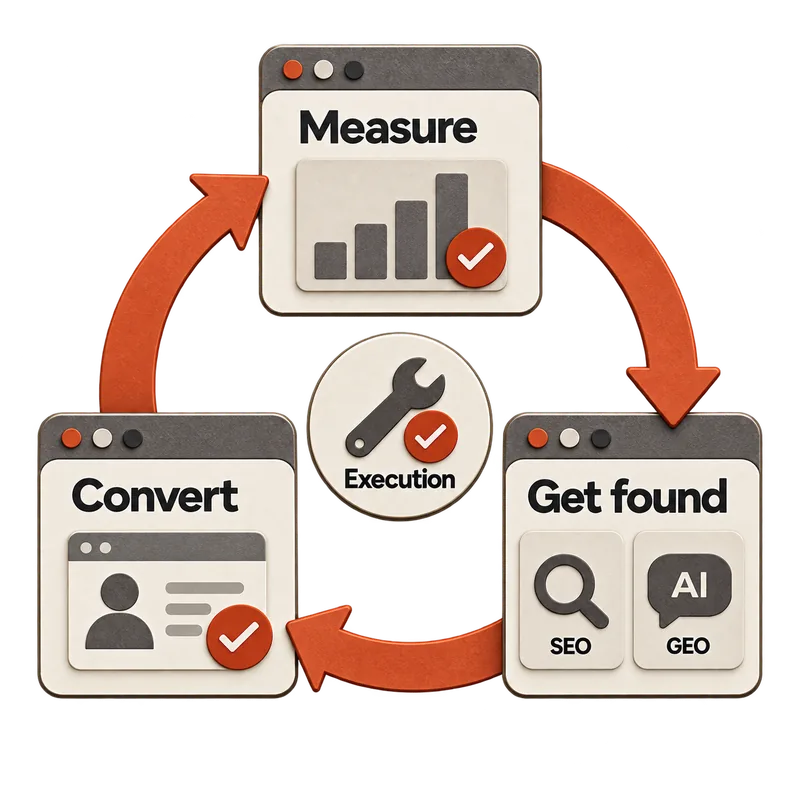
One loop, three moves
It starts and ends with measurement, and each pass starts with better data than the last.
Measure — what’s actually true.
Before anything changes: what’s tracked, whether it reconciles with your orders or inquiries, and what the current position really is. This is the baseline, and it’s also the thing that makes the next pass provable.
Get found — search and AI answers.
Two surfaces now, not one. They overlap heavily and they don’t score you the same way, which is why they belong to the same person rather than two vendors with different definitions of success.
Convert — visits into revenue.
What the site does with the visit: whether the intent matches, where the friction sits, and how fast the page arrives at all.
Then it starts over.
The return is the second measurement — did it work — and the beginning of the next round. A campaign ends. A loop gets sharper on every pass, because each round begins with what the last one proved.
Execution runs around the loop rather than inside it: I can implement the fixes too, or work with whoever does. Either way the plan doesn’t die at handover.
Why one person
Why these can’t be bought separately
The same fix serves two masters.
Page speed is a technical task and a conversion lever. Structured data is technical hygiene and the thing that lets a machine resolve who you are. Split the work across vendors and each one solves half of it — usually the half that’s easier to report on.
The money leaks between the parts, not inside them.
Ranking for a phrase your buyers don’t use is a definition failure, and it happens before the SEO starts. A page that converts badly may be perfectly built and pointed at the wrong query. Neither vendor is wrong. What connects their work has no owner.
One person has a limit — that’s the point.
I take a small number of clients at a time, because the model only works if the same head holds the whole picture. If you need five workstreams running in parallel next month, an agency is genuinely the better answer, and I’ll tell you so.
Why audits fail
Why most audits change nothing
An audit that ends at handover is a document, not a change.
Most audits are honest work. They fail anyway, for three ordinary reasons:
Nobody owns the next step.
The findings arrive as a list of problems, sorted by severity, with no order of work and no idea what each item costs. The list goes into a folder, and three months later the same problems are found again by someone else.
The findings need someone who can act on them.
A recommendation that has to survive a developer queue, a designer’s calendar and a marketing sprint plan usually doesn’t. That’s why the deliverable here is a priced work plan with the first fix already scoped — and why I implement, or work directly with whoever will.
Nothing is re-measured.
Without a baseline that was frozen before the work, the question “did it help” has no answer, so the next decision is made the same way as the last one: by opinion.
Every one of them reports success. The revenue doesn’t care.
Working together
How we’d work together
It starts with a baseline.
We record where the site stands and find what’s holding it back — and the first fixes ship in the same phase. How long that takes depends on the size of the site and the problem. We agree the tasks and the budget before we start.
Then a fixed scope, or a standing arrangement.
Project work when the fix list is known and finite. An ongoing arrangement when the loop needs holding — measure, fix, re-measure — and when there’s enough moving to justify it.
Where implementation fits.
On WordPress and WooCommerce I build the fixes myself. Elsewhere I work with your developer, in their process, at their pace — and when the platform itself is what’s blocking the fixes, I build the replacement.
What you get, always.
A written baseline before anything changes, the method behind every number, and the same number re-measured after. If a result can’t be attributed honestly, I’ll say that instead of claiming it.
Pricing model
What it costs.
I charge €50 per hour. Every figure below is hours × €50, so you can see what each budget buys.
Hourly consulting€50 / hour
Two example projects
B2B website
Around 500 pages
Ongoing engagement
- 01
Full audit & strategy
SEO, technical, AI visibility, conversion and measurement, in one audit and one plan.
€2,400
48 h · one-off
- SEO16 h
- Technical SEO8 h
- AI visibility8 h
- Conversion8 h
- Measurement8 h
- 02
Ongoing work
One prioritized plan across all five areas, with the measurement repeated.
€2,000
40 h / month
or
Standalone audit
Audit & handover
All five areas, with a fix list your team can work from
€3,200
64 h · one-off
Webshop
Around 5,000 products
Ongoing engagement
- 01
Full audit & strategy
SEO, technical, AI visibility, conversion and measurement, in one audit and one plan.
€3,600
72 h · one-off
- SEO24 h
- Technical SEO12 h
- AI visibility12 h
- Conversion12 h
- Measurement12 h
- 02
Ongoing work
One prioritized plan across all five areas, with the measurement repeated.
€3,000
60 h / month
or
Standalone audit
Audit & handover
All five areas, with a fix list your team can work from
€4,800
96 h · one-off
These are indicative budgets, not fixed prices. Server-side collection, Looker Studio dashboards and website builds are ordered separately, as on their own pages.
No VAT is added to these figures — I’m VAT-exempt under Hungarian law.
Why is it less than the five areas added up?
The five audits overlap. One crawl, one look at your data and one round of conversations serve all of them, so the combined audit costs less than five separate ones.
The same holds for the monthly work: one plan and one set of priorities, instead of five.
What the full audit covers
The full audit looks at the site from every side at once: how search engines crawl and understand it, how it shows up in AI answers, how visitors move through it, and whether the numbers behind all of this can be trusted.
You get one written strategy and one prioritized plan, with the estimated effort and who is responsible for each task, instead of five separate reports.
B2B website: from the first search to the inquiry
For a B2B website with around 500 pages, the audit follows the buying process from the first search to the inquiry: which pages bring buyers in, what they find, and where they drop out.
The ongoing work moves through the plan in order of effect: content and page improvements, technical fixes, AI visibility and conversion work, all measured against the same baseline.
Webshop: the whole catalog, in batches
For a webshop with around 5,000 products, the audit covers the catalog as a whole: templates, categories, filters, product pages, the checkout and revenue tracking.
The ongoing work improves the shop in batches and measures each batch, so it is clear what changed and what the change did.
What the monthly budget covers
Research, strategy, implementation or coordination with your developers, monitoring, meetings and reporting. Reporting time counts in the hours.
You get access to the project management tool, where you can see the priorities, who is responsible, progress and what comes next. Each month starts with agreed priorities and ends with a review of what changed and what the data shows.
Priced separately
Content writing and production, including an external writer if needed.
Outreach and digital PR. The audit includes the backlink analysis and recommendations.
Setting up or repairing measurement. The audit analyzes your existing data; new tracking and integrations are scoped separately.
Development beyond the agreed hours, including external developer fees.
AI search research or monitoring beyond the agreed topics, languages and AI systems.
Before you start
You receive a proposal with the scope, the estimated hours, the audit fee and the monthly budget. It also states whether the first phase includes implementation, when the ongoing work begins, and what your team needs to provide.
There is no lock-in. Any change to the scope or budget is agreed before the extra work starts.
Entry points
The five areas
Same loop, five entry points. Which one you start from depends on where the problem is — and if you’re not sure, the diagnosis decides.
Search / SEO consulting
Being found for the phrases your buyers actually use, on a site search engines can read. Includes the technical layer.
Search / SEO consultingAI visibility (GEO)
Whether AI systems name you when someone asks about your category, and whether they can resolve who you are at all.
AI visibility (GEO)Conversion optimization
What the site does with the visit: intent match, friction, speed.
Conversion optimizationMeasurement and analytics
What’s tracked, whether it’s true, and which few numbers are worth deciding from. Opens and closes every round.
Measurement and analyticsExecution
Getting the fixes actually shipped — direct build or structured oversight, one ranked queue, a measurement after every change.
ExecutionQuestions
Questions people ask about the model
Do I have to buy the whole loop?
No. Most people start with one specific problem. The loop shows how the work connects, not what you have to buy.
When do the first fixes ship, and when do you see results?
The first fixes usually ship within the first few weeks. Once a fix is live, I check that it works. Judging its effect on traffic and conversions takes longer and needs enough data — how long depends on your traffic and the kind of change.
What if I already have an agency?
Then the useful question is which part nobody owns. I’ve worked alongside agencies on exactly that — the technical layer, or the measurement, or the entity work nobody was asked to do. It doesn’t have to be an either-or.
Why one person instead of a team?
Because the failures I see happen where one person’s work ends and the next begins — and that gap disappears when one head holds the whole picture. The cost is capacity: a small number of clients at a time, and no promise of five parallel workstreams.
Next step
Not sure which area you need?
Describe what’s not working — traffic, conversion, or the fact that you can’t tell. I’ll say which area it is, and whether it’s worth starting at all.