Because the friction list is worth having even if you never hire me for the fixes. It’s a specific, ordered document about your own site, not a set of best practices you could have read anywhere. And if the audit finds the problem is upstream — wrong traffic, not a broken page — you’ll know that before spending anything on design work.
Conversion rate optimization consulting
Traffic that doesn’t convert is a cost, not an asset.
One consultant for the whole path: why people arrive, what they meet when they do, and where they quietly give up. For ecommerce and B2B sites where the traffic already exists and the revenue doesn’t match it.
Problem
The traffic is there. The revenue isn’t.
Sessions look healthy. The funnel report says people drop off somewhere in the middle. So you rewrite a headline, move a button, add a testimonial — and the number doesn’t move, because nobody knew why they were leaving in the first place.
The uncomfortable version: sometimes the visitors were never going to buy. They arrived for the wrong reason, and no amount of layout work fixes that. That’s why I don’t start at the landing page.
Symptom 01
Traffic keeps growing. Conversions don’t follow.
The acquisition works. The site doesn’t capture it — and the gap widens with every paid click and organic visit that fails to convert.
Symptom 02
We have analytics but no idea where people drop off.
The data exists. It just isn’t tied to the moments where a willing buyer hesitates, so the funnel has stages and no reasons.
Symptom 03
We redesigned the site. Conversions didn’t improve.
The visual layer got fixed. The decision layer — what’s said, in what order, before what commitment — didn’t, because nobody measured it first.
Symptom 04
The checkout abandonment rate is too high.
The most expensive place to lose someone: they had already decided. A field, a surprise cost, a slow step on a phone — small friction here costs more per instance than anywhere else on the site.
What this is
Search and conversion are one problem
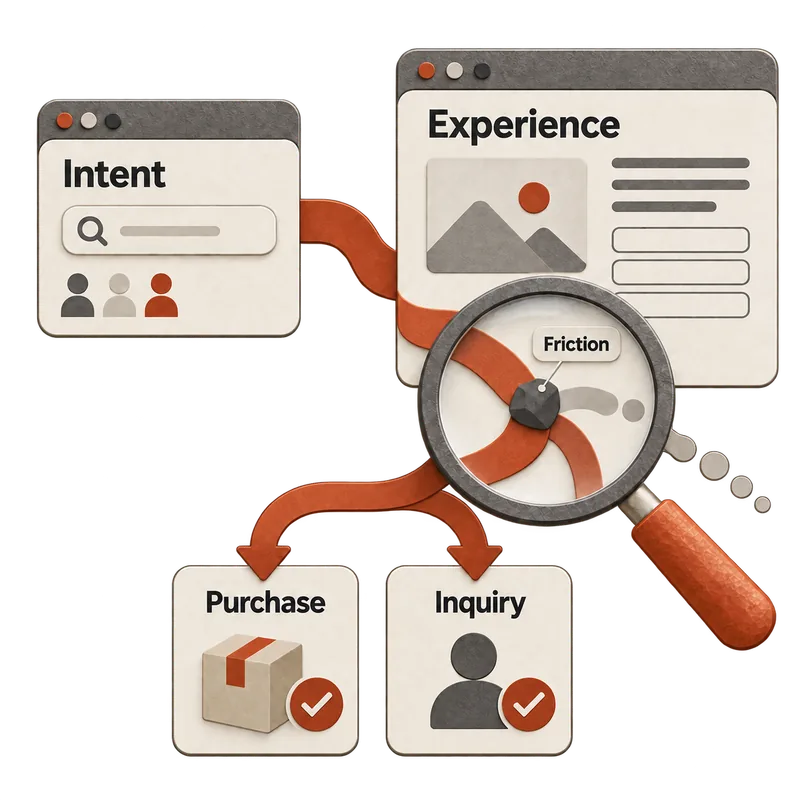
A conversion problem is often a traffic problem that arrived earlier.
Intent first
Before behavior, the question is who’s arriving and what they came for. A page that barely converts may be perfectly built and pointed at the wrong query. This is where conversion work and search work meet, and why splitting them across two vendors costs you twice.
Then friction
Once the intent matches, the question becomes what stops people who genuinely wanted to buy. Not opinions about the design: recorded behavior, drop-off points, and the moments where hesitation turns into a closed tab.
UX, in the narrow sense
Layout, clarity, forms, mobile behavior, and the distance between arriving and deciding. This is the part most people call UX, and it’s the last third of the work, not the first.
How it works
How the work runs
Intent check — who’s arriving, and why.
Query data against page purpose. If they don’t match, this is where the work stops being CRO and starts being search. If the site is new and there’s no behavior to read yet, intent comes from search data instead — what people in your category actually type, and what they expect to find. Different source, same question.
Tools: Google Search Console · Microsoft Clarity · DataForSEO
Behavior — what people actually do.
Session recordings, click and scroll patterns, drop-off points. Not a survey, not an opinion: the recorded thing.
Tools: Microsoft Clarity · GA4
Friction — the specific list.
Every point where a willing buyer hesitates, ranked by how many people hit it. This is the deliverable, and it’s priced per item.
Tools: Microsoft Clarity · GA4
Speed — the friction nobody photographs.
A slow page loses people who never appear in a heatmap, because they left before it rendered. On one ecommerce site the correlation with completed purchases was −0.81.
Tools: PageSpeed Insights · WebPageTest
Verify — did the number move.
The same measurement, re-run against the baseline. Where traffic allows it, a test; where it doesn’t, a before-and-after with the method written down.
Tools: GA4 · BigQuery
Ecommerce
Ecommerce, specifically
Product pages, cart, and checkout behave differently from a B2B inquiry path: the decision is faster, the abandonment is measurable, and small friction costs compound across every order.
Where the money leaks
Checkout steps that ask too early, shipping costs that appear too late, product pages that answer the second question but not the first, and mobile performance that quietly halves the completion rate.
What I don’t do
I don’t run discount tactics or urgency banners. They move a number for a week and cost you margin and trust. The fixes here are structural.
WooCommerce and Shopify are both familiar ground — on WooCommerce I implement the fixes myself.
Where it breaks
Nobody abandons a cart because of a button color.
These are the six things they abandon it for.
Clarity friction
They can’t tell in five seconds what this is, who it’s for, or why it’s different. Hero sections that list features instead of outcomes; navigation in the company’s internal language.
Decision friction
Too many options and no obvious next step. Pricing without context, service pages without specifics, forms that ask for too much too early.
Trust friction
No specific proof at the moment it’s needed. Testimonials that say nothing, no author behind the claims, terms that raise perceived risk instead of lowering it.
Structural friction
Dead ends in navigation, mobile breakage, hidden CTAs, the key action three scrolls down. And the conversion page that organic visitors can’t reach at all.
Intent mismatch
Informational traffic landing on a page built to sell, and buyers landing on a page built to explain. Search and UX working without a shared map of who’s arriving.
Form and checkout friction
Field count, validation that blocks instead of guides, no progress indicator, no trust signal at the commitment step. The most expensive friction on the site, because the visitor was almost there.
Diagnosed from recorded behavior — session recordings, heatmaps, funnel data — not from opinion.
The audit
The audit
A UX and conversion audit — intent, behavior, and the friction list, in that order.
Where your visitors come from and what they came for, what they do once they arrive, and every point where a willing buyer gives up — ranked by how many people hit it, priced per fix.
Why this first
Pricing model
What it costs.
I charge €50 per hour. Every figure below is hours × €50, so you can see what each budget buys.
Hourly consulting€50 / hour
Two example projects
B2B website
Around 500 pages
Ongoing engagement
- 01
UX & conversion audit
Where visitors come from, what they do, and where willing buyers give up on the pages that bring inquiries.
€800
16 h · one-off
- 02
Ongoing work
Agreed fixes on forms, service pages and contact paths, measured before and after.
€800
16 h / month
or
Standalone audit
Audit & handover
Findings ranked by effect, with a fix list your team can work from
€1,200
24 h · one-off
Webshop
Around 5,000 products
Ongoing engagement
- 01
UX & conversion audit
Category, product page, cart and checkout, ranked by how many buyers each problem stops.
€1,200
24 h · one-off
- 02
Ongoing work
Fixes on the key templates and the checkout, each change measured.
€1,500
30 h / month
or
Standalone audit
Audit & handover
Findings ranked by effect, with a fix list your team can work from
€1,800
36 h · one-off
These are indicative budgets, not fixed prices. Traffic volume, the platform, the number of templates and how much tracking is already in place all change the final quote.
No VAT is added to these figures — I’m VAT-exempt under Hungarian law.
Why is the audit lower with ongoing work?
An audit on its own has to work without me. Every finding is written up with the evidence behind it and a proposed fix, so your team can act on it.
As the start of ongoing work, the audit finds the biggest problems first. Detailed analysis of the remaining pages continues within the monthly hours, alongside the fixes. That is why it costs less upfront.
What the audit covers
The audit starts with your data: where visitors come from, what they came for, and what they do once they arrive. I use Google Analytics, Search Console and, where available, Clarity recordings and heatmaps, and I walk through the key paths myself on desktop and mobile.
Every point where a willing buyer gives up is ranked by how many people hit it. You get a prioritized list of fixes, each with the evidence behind it.
B2B website: from visit to inquiry
On a B2B website with around 500 pages, a handful of pages bring most inquiries: service pages, case studies, pricing and the contact page. The audit follows the paths that lead there and finds where they break.
The ongoing work fixes those paths: clearer service pages, shorter forms, and contact options that match how buyers decide. Each change is measured against the period before it.
With B2B volumes, a change often needs weeks of data before it can be judged, so the monthly plan states what is measured and when.
Webshop: category, product and checkout
On a webshop with around 5,000 products, a few templates carry most of the revenue: category pages, product pages, the cart and the checkout. The audit ranks the problems on each template by how many buyers they stop.
The ongoing work improves one template or step at a time and measures the change before moving on. On WooCommerce, I make the changes myself; on other platforms, I work with your developers.
What the monthly budget covers
Research, strategy, implementation or coordination with your developers, monitoring, meetings and reporting. Reporting time counts in the hours.
You get access to the project management tool, where you can see the priorities, who is responsible, progress and what comes next. Each month starts with agreed priorities and ends with a review of what changed and what the data shows.
Priced separately
Content writing and production, including an external writer if needed.
Outreach and digital PR. The audit includes the backlink analysis and recommendations.
Setting up or repairing measurement. The audit analyzes your existing data; new tracking and integrations are scoped separately.
Development beyond the agreed hours, including external developer fees.
AI search research or monitoring beyond the agreed topics, languages and AI systems.
Before you start
You receive a proposal with the scope, the estimated hours, the audit fee and the monthly budget. It also states whether the first phase includes implementation, when the ongoing work begins, and what your team needs to provide.
There is no lock-in. Any change to the scope or budget is agreed before the extra work starts.
Related areas
This connects to the rest of the loop
Search / SEO consulting
Where the visit comes from, and whether it arrived for the right reason.
Search / SEO consultingMeasurement
If the data is wrong, every conversion decision after it is a guess.
Measurement and analyticsExecution
The friction list is priced per fix. This is where the fixes get shipped — or handed over with the method written down.
ExecutionAI visibility (GEO)
Visitors who arrive from an AI answer already had the comparison made for them. Different intent, different friction.
AI visibility (GEO)Questions
Questions people ask about conversion work
Do I need A/B testing?
Usually not, and I’ll tell you when. Testing needs enough conversions to reach significance — most sites I see would need months per test. Until then, fixing recorded friction beats measuring opinions slowly.
How is this different from hiring a CRO agency?
A conversion rate optimization consultant looks at the whole path; a CRO agency usually starts at the landing page. An agency assigns a team: someone reads the data, someone designs, someone reports. The split works when the problem is inside one page. It fails when the problem is that the wrong people are arriving — because then the answer isn’t design work at all, and nobody in the room owns search.
Isn’t this a designer’s job?
Partly. A designer makes the page good; this work finds out which part of the page is costing you money, and what specifically to change. If you have a designer, the friction list is what you hand them.
What if my traffic is too small for any of this?
Then say so early and we’ll check. Below a certain volume, conversion work is guesswork, and your money is better spent getting the right people to arrive at all — which is a different page.
Next step
Want to know where people give up?
Tell me which page matters most and what it’s supposed to achieve. I’ll tell you what the behavior data shows — and whether the problem is the page or the traffic.