Clicks fell 14%. Rankings didn’t move.
A B2B SaaS site kept its impressions and its positions, and lost 14% of its clicks over six months. What that changed about which pages are worth improving.
When impressions hold and positions hold and clicks fall anyway, the problem isn’t ranking. The answer is being delivered somewhere you don’t control.
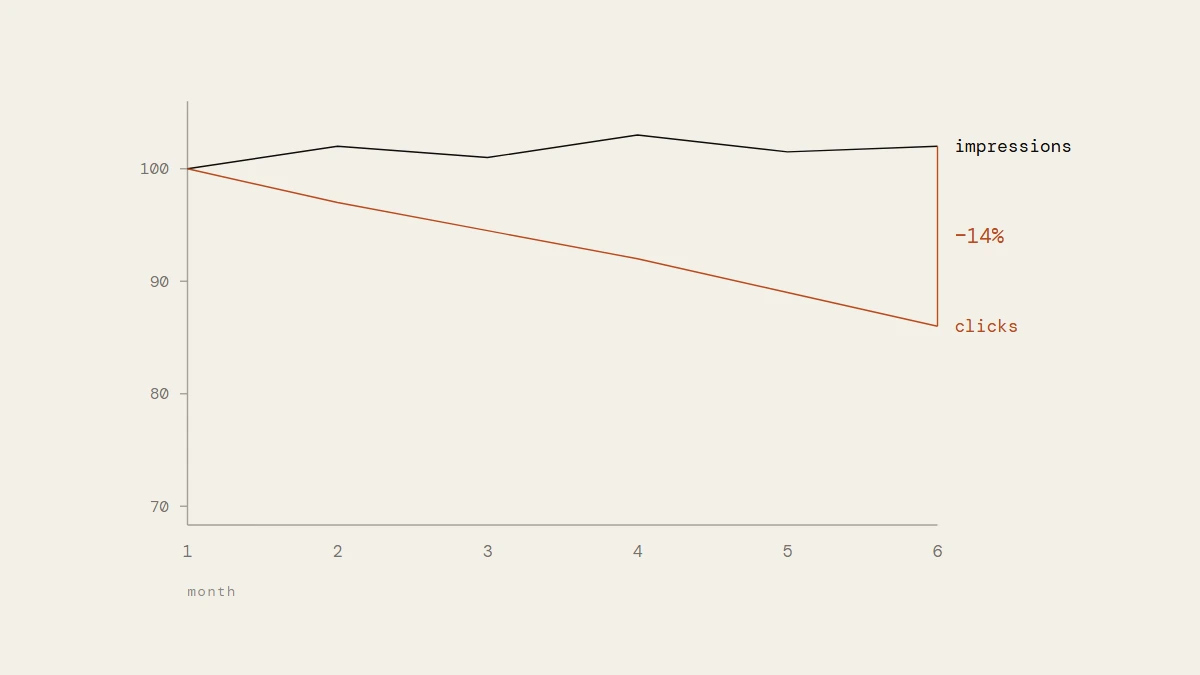
Own measurement, six-month window; monthly values redrawn from the reported change.
| −14% | Organic clicks, six months | ≈2–3% per month |
|---|---|---|
| unchanged | Impressions and average position | slightly improved in some query groups |
| 6,000–7,000 | Monthly organic clicks, baseline | — |
| 100,000+ | Copilot / Bing AI impressions in period | — |
| 20 | Clicks from those impressions | ≈0.02% CTR |
| +41.9% | Decision-stage impressions after six months | 952 → 1,351 |
| 423 | AI/referral visits in reviewed month | producing 30 conversions |
Own measurement · Search Console + Bing Webmaster Tools + BigQuery · anonymized international B2B SaaS company in a regulated market.
More than 500 posts, and traffic still declining
The site had over 500 blog posts — years of regulatory topics, country requirements, explainers and guides. From a traditional B2B search perspective this had been a logical strategy: if someone searched a problem or a regulatory question, there was a good chance they’d meet the company.
Then search traffic started to weaken. Not a collapse — a gradual decline of 2–3% a month, adding up to 14% over six months. On its own, a monthly 2–3% looks like noise. Fourteen percent starts to suggest something is changing.
What made it interesting: impressions and average position didn’t decline. In some query groups they slightly improved. This was an English-language site across several major markets, 6,000–7,000 organic clicks a month — not a sample small enough for a few queries to distort.
That’s the situation where the usual explanations need ruling out carefully. Title and meta changes affect click-through rate — but competitor pages were monitored continuously, and we knew exactly when content had changed on the client’s own site.
Why the clicks left
After ruling out on-site and competitor changes, the growth of AI answers fit the data. Not as a proven single cause — as a market shift consistent with the pattern.
And the pattern was specific: the company hadn’t disappeared from results. Visibility remained for informational searches; fewer people needed to click. When a page loses rankings the story is simpler — it ranks lower, it gets fewer clicks. Here the visibility stayed and the click stopped being necessary.
This was clearest for explanatory intent: a regulatory concept, a country-specific requirement, a basic process. For those, an AI Overview or a Copilot answer is often a good enough first answer.
That doesn’t make the content worthless — it changes its job. An informational post used to be an entry point. Now the same content may work as background material: covering the topic, supporting entity signals, appearing as a source. It just may not bring the clicks it did three years ago.
Measuring something that isn’t a channel
AI search traffic can’t be measured cleanly. Search Console doesn’t mark which queries appeared in AI Overviews or AI Mode, so you can’t filter for them. You approach it indirectly.
First, regex on Search Console query data for searches longer than eight words, plus question-based searches separately. This doesn’t prove a query came from an AI surface — AI-style searches are simply longer, more conversational and more specific. Some analysts use 10+ words; I used 8+ as a broader practical signal, not as proof.
Then the same logic on Bing Webmaster Tools: how many impressions those longer, question-like queries generated, how many clicks they brought, and whether any conversions followed.
One data point showed the size of the gap. In the period reviewed, Bing Webmaster Tools recorded more than 100,000 impressions across Copilot and Bing AI Answer surfaces. Those impressions produced 20 clicks — roughly a 0.02% click-through rate. It’s hard to find a cleaner illustration of the distance between being visible in an AI surface and getting a visit.
The decision that followed
The finding wasn’t that the content was bad. It was that volume wasn’t the missing piece — the site was, if anything, weighted too heavily toward informational content.
So the work moved to MOFU and BOFU pages: solution pages, industry pages, use cases, comparisons, pages answering a specific business problem. Not to win back every lost informational click — in many cases that’s unrealistic — but to be present in the situations where someone has stopped learning and started deciding.
In B2B SaaS these pages rarely bring the most traffic. That isn’t their job. A finance, compliance or operations lead doesn’t contact a vendor because of a definition. They do it when they understand the problem, see the risk, and want to know the options.
Query fan-out drove the content changes. A complex question doesn’t stay one question in an AI system: it’s broken into related sub-questions, each answered from whatever source fits. In a regulated market those sub-questions are decision questions — which countries does this affect, what’s the risk of getting it wrong, which internal teams are involved, when is a manual process enough, what integrations are needed, how do providers compare.
The pages didn’t just get longer. They got a different job: decision criteria, common mistakes, internal objections, implementation questions, compliance risk — and explicit sections on when the solution isn’t needed. That last part matters more than it looks. A page that helps the reader see the problem clearly is more credible than one trying to convince everyone immediately.
E-E-A-T here isn’t decoration, it’s trust infrastructure. In a market with legal, financial and compliance implications, it isn’t enough for content to be well written: it has to be clear who stands behind it, what it relies on, and how the company connects to the topic. Author pages, expert references, external mentions, structured data, update dates, entity signals. For one author we managed to create a Wikidata entry — a useful signal for AI systems.
And page types stopped being treated identically. A blog post, a solution page, an industry page and a comparison page have different jobs, and often need different schema, internal linking and calls to action. Many projects blur that; in practice it matters.
What moved
Measured over six months, first month as baseline against the sixth:
Decision-stage visibility improved. Impressions for filtered decision-stage, AI-style searches rose 41.9% — from 952 to 1,351. An impression isn’t a business result, and I wouldn’t oversell it. It did show the revised pages were appearing in more relevant situations.
AI/referral traffic became measurable. In the month reviewed, AI and referral sources brought 423 visits producing 30 conversions — book-a-call actions and newsletter sign-ups — against roughly 500 conversions a month company-wide. The number matters less than the fact that the segment became measurable at all, and kept growing.
Attribution stays imperfect, and that’s worth saying plainly: if someone meets the company in an AI answer and returns later through a brand search, analytics won’t credit AI search. Referral data shows the visible part only.
The lesson: not every lost click is worth winning back
Content volume is becoming less valuable on its own. Hundreds of posts are a foundation, but they don’t protect you from informational searches moving into generated answers. The website’s role doesn’t disappear — it changes.
The better question isn’t “how do we win back every lost click?” It’s: which pages support real buying decisions, and how do they perform in search, in AI answers, and in the business?
What to check on your own site
- Compare clicks against impressions and average position over six months, not one.
- Filter your Search Console queries for 8+ words and look at what’s there.
- Check Bing Webmaster Tools for Copilot impressions — most people never look.
- Separate your informational pages from your decision pages, and measure them differently.
- Ask which of your pages a buyer would read after they’ve understood the problem.