Ecommerce SEO consulting
Ecommerce SEO consulting makes an online store’s categories and products findable in search: which page should answer which search, which filtered and product pages search engines should index, and how product data reaches the results. As an ecommerce SEO consultant I work on Shopify and WooCommerce stores, including catalogs of more than 10,000 products, from the audit to the fixes in the store.

When you need ecommerce SEO consulting
Ecommerce SEO consulting is needed when the store works, but search brings fewer shoppers than your range should, or traffic fell after a change. These are the situations in which online stores most often look for an ecommerce SEO consultant:
You changed platform or theme, and traffic fell. With a new ecommerce platform, a new theme or a new domain, old product and category URLs, settings built into the theme, structured data and apps don’t carry over on their own. If you haven’t moved yet, these are worth checking before go-live.
Your products don’t show up in Google. Search Console says the product pages are crawled but not indexed. They often carry manufacturer or supplier descriptions, and many pages are almost identical.
Filters and variants generate thousands of URLs. Combinations of color, size, price and brand create so many pages that the crawler spends its time on them, and you don’t know which filtered page deserves a place in search.
Category pages bring no traffic. Some products rank, the categories don’t, or a search shows a product or a blog post instead of the category.
Out-of-stock or discontinued products are costing you rankings. Search Console shows hundreds of 404s, or you’re deciding between a redirect, an out-of-stock label and a preorder.
Product rich results have dropped. Search Console shows fewer valid product items, or the number of approved products in Merchant Center is falling, even though the store has barely changed.
You’ve had SEO work done, and the results don’t show. Money and time went into it, traffic or orders didn’t move, and you need a second opinion on what should come first.
Ecommerce SEO audit: what I check
An ecommerce SEO audit goes through the store from the catalog’s side: which page answers which search, what search engines index of it, and how product data reaches the results. These are the areas, and what I check in each:
Categories and search intent. A category page is the product list most buying searches land on, such as “men’s hiking boots” or “garden pump”. I check which page answers which search, and what page type the results page expects: a category, a product or a guide. In the category structure I look at depth and naming, and at where a category is missing that has demand and that competitors already cover.
Filters and variants. Faceted navigation can create a new URL for every combination of color, size and price. I decide filtered page by filtered page: one that has searches and enough products becomes an indexable page with its own title; the rest stay out through canonicals or robots rules, so the crawler’s time goes to the pages that matter. For variants (color, size) I check which have searches of their own and which should be part of the product page.
Product pages and product data. A product page is more likely to get into the index and stay there when it offers something the manufacturer’s site and other stores don’t: its own description, exact specifications, identifiers (SKU, GTIN), practical details. I check where product data comes from (supplier feed, PIM or manual entry), and where it’s worth enriching the template with data instead of rewriting every description by hand. How many shoppers the product page convinces is part of conversion rate optimization.
Crawling and indexing. For indexing I check what share of product and category URLs are in the index. Crawls, server logs and the sitemap show whether the crawler reaches the pages that matter; on a headless store also whether it sees the content without JavaScript, and what CDN and edge settings change. I look at Core Web Vitals by template: category, product, cart. If the issue sits deeper (server, rendering), it’s part of a technical SEO audit.
Structured data and Merchant Center. Product structured data (name, price, currency, availability, reviews) is what produces product rich results in search. I check whether it matches the page and the product feed, because if price or availability differ, Merchant Center can reject the product, and the rich result can disappear too.
Internal links. Internal links take the crawler and the shopper from categories to products. I check whether every important product can be reached in a few clicks from the categories, how pagination and related-product blocks work, and whether link text says where it leads.
Platform and templates. The platform decides what can be solved in settings and what needs a developer or an app. On Shopify the URL structure is fixed (/products/, /collections/) and many SEO settings live in apps; on WooCommerce permalinks and filter plugins cause surprises. Before a platform change, this is where I check how each product and category URL, template setting and app will move to the new system. I also look at the release process: who can make changes, and how long it takes for a fix to go live. If you sell in several countries, currencies and country stores are part of international SEO.
Out-of-stock, discontinued and seasonal products: what happens to their pages
An out-of-stock or discontinued product page isn’t a fault to make disappear, it’s a decision: decide well, and you keep both the ranking and the shopper. This is how I decide:
Temporarily out of stock: the page stays, the availability shows on the page and in the structured data, and the shopper finds similar products on it.
Discontinued, with a successor or a close match: a 301 redirect to the successor. To the category only if the shopper finds what they were looking for there.
Discontinued, with no successor, no traffic and no links: a 404 or 410, and the URL comes out of the sitemap and the internal links.
Seasonal product: the page stays all year and is updated for the next season, so it doesn’t start from zero every year.
If only one variant is out of stock, the whole product shouldn’t look out of stock in search: the structured data should follow each variant’s availability.
A preorder when it’s a real preorder: you don’t need to advertise preorders months ahead to keep a ranking.
For a large-scale phase-out, when a whole product line goes, the decisions are made up front, in a list: which URL points where, and which one goes.
The number of redirects isn’t a problem in itself; chains and wrong targets are.
Ecommerce in AI search
Ecommerce in AI search competes on product data: ChatGPT, Perplexity and Google’s AI Mode recommend products too, and they read the name, price, availability and specifications to do it. So the data has to match on the product page, in the structured data and in the product feed. Whether your products appear in AI answers can be measured, but I don’t promise they will. Measuring it is part of generative engine optimization (GEO).
How I work: the ecommerce SEO process
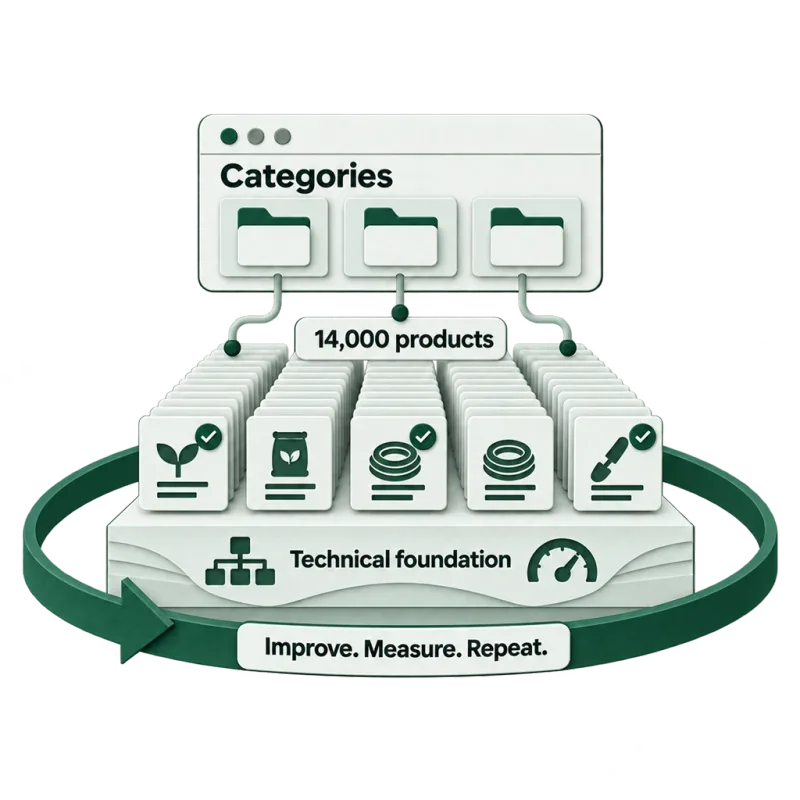
Ecommerce SEO has seven steps for me. I look at the same metrics before and after the work, by category and product group, so you can see what each change delivered.
01
Discovery
The first step is the goal: which categories and product lines bring in revenue, which are growing and which aren’t, and who works on the store. I also look at the platform, the apps and the release process: who can make changes, and how a change goes live.
02
Baseline
The baseline records where we start, by page group (categories, products, filtered pages): impressions, clicks and click-through rate in Search Console, organic sessions, orders and revenue in analytics, and the share of products indexed. If consent management means analytics misses part of your shoppers, I account for that.
03
Audit
The audit goes through seven areas: categories and search intent, filters and variants, product pages and product data, crawling and indexing, structured data and Merchant Center, internal links, and platform and templates. I also check how you handle out-of-stock and discontinued products. The result is a task list prioritized by page type.
04
Strategy and roadmap
The strategy starts with a keyword-to-page map: which search is answered by which category, product or filtered page, and where a new category is needed. In the roadmap every item says who owns it, how much work it is, and which metric it will show up in. If you ask for a forecast, I give it with its assumptions: what search volume, click-through rate and conversion rate it rests on.
05
Implementation
On Shopify and WooCommerce I make the fixes myself; on other platforms I write developer tickets that go into your sprints. I tell you up front how much developer time each item needs, so it fits your capacity. I check before and after each release that the fix didn’t break anything else.
06
Maintenance and handover
A store keeps changing: new products arrive, old ones are phased out, one season follows another. In maintenance I keep this in order with your team and check the releases. If you have an in-house SEO, I work with them; if your team takes over, I train them to decide on new categories, filtered pages and discontinued products.
07
Re-measurement by category and product group
Re-measurement happens by category and product group. In analytics I look at organic revenue, orders and conversion rate by landing page, in Search Console at the visibility of non-brand searches, and I compare all of it with the same period a year earlier and with the groups we didn’t touch. If traffic is large enough, I measure the effect with a template-level split test. Seasonality and Google updates can’t be separated out precisely, so I mark them separately. I don’t promise timelines. I tell you what we measure and what we compare it against.
Proof
+38%
Google impressions, Oct 2026 vs. Oct 2025
SEO on a catalog of 10,000+ products
A ShopRenter catalog of 10,000+ products, restructured in two-week sprints from March to September. Traffic held during the changes; in October, impressions were 38% above the year before.
Case study: SEO for a large e-commerce catalog
Impressions, Oct 2026 vs. Oct 2025 · Google Search Console
Pricing
I charge €50 per hour. Every figure below is hours × €50, so you can see what each budget buys.
Hourly consulting€50 / hour
Example project
Online store
A store of around 5,000 products
- 01
Ecommerce SEO audit
Categories and search intent, filters and variants, product pages, indexing, structured data and feed, discontinued products; a task list prioritized by page type.
€1,000
20 h · one-off
- 02
Optional monthly maintenance
For larger stores, I hand over tasks or implement changes in planned stages. This helps us track their effects and reduce the risk of a traffic drop caused by making too many changes at once. The time can also cover new products and phase-outs, seasonal changes, release checks and Merchant Center monitoring.
€800
from 16 h / month
These are indicative budgets, not fixed prices. The platform, the number of templates, how the site is built and what the audit finds all change the final quote. Link earning and digital PR are priced separately.
No VAT is added to these figures — I’m VAT-exempt under Hungarian law.
When does ecommerce SEO pay off?
Ecommerce SEO pays off when orders from search bring in more than the consulting, your developers’ time and cleaning up the product data cost. The audit costs around €1,000. If you earn €25 on an average order, around 40 organic orders cover the audit fee. The optional monthly work and any other implementation costs are additional. You don’t pay per click for an order that comes from search, so every new organic customer lowers your average acquisition cost. Delay has a price too: as long as a product line isn’t indexed, ads are the only way to reach shoppers searching for it.
What the monthly budget covers
Research, strategy, implementation or coordination with your developers, monitoring, meetings and reporting. Reporting time counts in the hours.
You get access to the project management tool, where you can see the priorities, who is responsible, progress and what comes next. Each month starts with agreed priorities and ends with a review of what changed and what the data shows.
Priced separately
Content writing and production, including an external writer if needed.
Outreach and digital PR. The audit includes the backlink analysis and recommendations.
Setting up or repairing measurement. The audit analyzes your existing data; new tracking and integrations are scoped separately.
Development beyond the agreed hours, including external developer fees.
AI search research or monitoring beyond the agreed topics, languages and AI systems.
Before you start
You receive a proposal with the scope, the estimated hours, the audit fee and the monthly budget. It also states whether the first phase includes implementation, when the ongoing work begins, and what your team needs to provide.
There is no lock-in. Any change to the scope or budget is agreed before the extra work starts.
Questions
What exactly do we get, and what does it cost?
After the audit you get a task list prioritized by page type: what the issue is, how big its impact is, how much work it takes, and who does it. The recommendations also say which page should answer which search. The price is hourly, €50/hour; an audit of a store with around 5,000 products takes about 20 hours.
Can an SEO app or plugin replace a consultant?
Part of the work, yes: apps fill in metadata, add structured data and handle redirects. What they don’t decide is which filtered page should be indexed, which category is missing, or what to do with a product line being phased out. An app is worth configuring after those decisions, not instead of them.
We’ve paid for SEO before and nothing improved. What will be different?
I start from what’s there now: what search engines index, which page answers which search, and what the data shows about the earlier work. I don’t assess the previous provider; I tell you what matters in your store now, and what we measure so the results show.
Should we start with category pages or product pages?
Usually with categories, because most buying searches are category-level, and one good category page takes traffic to many products. We start with products when revenue rests on a few products, or when products aren’t indexed.
Why don’t our products show up in Google when they’re in the feed?
The feed is for Merchant Center; organic results come from the index, and Google decides on the two separately. If a product page isn’t indexed, it’s often too similar to other pages, has little content of its own, or the crawler doesn’t reach it. If price or availability differ between the feed and the page, the product rich result can be missing too.
Should we index filtered pages or block them?
Not all of them the same way. A filtered page that has searches and enough products can get its own title and be indexed; the rest should stay out. Pages that are already indexed aren’t removed with a robots block, because then search engines can’t see the noindex.
Do we need to rewrite every product description? Can AI write them?
Not every one. It’s worth starting with the products that bring the most revenue and answer the most searches; for the rest, enriching the template with data is often enough. AI can write them too, if the text is accurate and adds something to the manufacturer’s description. Google’s spam policies are about mass-produced pages that add little, not about the tool.
We’re moving to a new ecommerce platform. What should we watch for with product and category URLs?
Every old product, category and filtered URL needs a new counterpart, or a decision that it goes. Settings built into the theme (titles, canonicals, structured data), apps and the product feed don’t carry over on their own, so we check them before go-live. Running the move itself, the redirect plan and the staging check are part of technical SEO consulting.
Most of our traffic comes from ads. Is SEO worth paying for?
Ads bring shoppers for as long as you pay for them; you don’t pay per click for an order that comes from search. Most stores need both. Organic traffic lowers what a new customer costs on average, and how much you depend on ad prices.
When will it show in our orders?
I don’t promise timelines, because search engines process changes at different speeds depending on page type and catalog size. It shows in indexing and impressions first, in orders later. I tell you what we measure: the share of products indexed, the visibility of categories and organic orders.
Products not showing up in search?
Send me your store’s address, and I’ll tell you where to start.