Why I built my own SEO audit app
Why I built my own SEO audit app with AI coding agents, why the first version failed, and what the second one measures that my other tools didn’t: content breadth, depth and quotability.

An SEO (search engine optimization) audit app is software that crawls a website and turns what it finds into a list of problems to fix. I built my own over the past six months, alone, with AI (artificial intelligence) coding agents writing the code from my specifications. The first version failed. The second one is built on a month of research into how search engines and AI assistants read a page, and it measures something my other tools didn’t: the breadth and depth of a page’s content, and whether its text can be quoted in an answer. I already use it on audits. Its working name is the AAA app, and it isn’t public yet.
The gap in the SEO tools I used
The gap in the SEO tools I used was the step between the data and the decision. Before the app, I ran Screaming Frog, which crawls a site and lists technical problems URL by URL, and put everything else together by hand, page by page: whether a service page says what the service includes, whether two service pages describe the same thing, whether a page explains a concept without once using its name.
That manual part is on-site SEO, one half of what I call machine-view SEO. Machine-view SEO is the part of search engine optimization that deals with how a website looks to the systems that crawl, index and interpret it: Googlebot, Bingbot, and the retrieval systems behind AI assistants such as ChatGPT and Gemini. The other half is technical SEO. The human view is how the same site looks to a buyer. I introduced the split in What investments are required for SEO in an AI era?
AI search made machine-view SEO harder to leave to hand work, because the first reader of a page is often no longer a person. An AI assistant can retrieve passages from several sites and write an answer from them, and the buyer may decide without opening any of the pages. I expected someone to build an audit tool that reads a site the way those systems do. If I didn’t build it, someone else would, and I would end up using their version of my own method. I started in May 2026.
The first version failed
I knew the first version of the app was done when I opened a report and saw three different scores for the same measure, on the same page, in three different places. By the end of the summer, I had built a single-page audit tool where AI agents collected data on one URL and wrote summaries around it—and logged 298 Jira tickets getting there. The architecture was wrong, the entity map meant to show what a page was about didn’t work, and nothing in the output justified building a tool of my own.
The approach was wrong, so I started again, using the experience behind those tickets to rethink the app from the ground up.
Entity research, the breakthrough
Instead of rushing to rebuild the app, I stepped away from it in mid-October and spent four weeks on the one piece the first version got wrong: entity research—identifying the services, products, categories, companies, and concepts a page talks about and how they connect. Outside the app, I ran large language models (LLMs) on real pages, verified every extracted entity against the actual text, and scored the output against pages I had labeled by hand.
This research was the breakthrough. It gave me a much clearer picture of how search engines and AI systems read a page, and three findings changed how I work.
A page is read in pieces. When I gave a model a whole page at once, it lost track and missed things. It worked once the page was split into sections and blocks. AI search systems also retrieve passages rather than whole pages, so I now check whether each section names its own subject.
A topic comes with an expected set of concepts. A page about technical SEO is expected to cover crawling, indexing, rendering and a few dozen related ideas. Comparing that set with the page shows which concepts the page explains, which it only mentions and which it misses.
Explaining a concept isn’t the same as naming it. On my own site, about two-thirds of the concepts my pages explained weren’t named the way the model names them. A reader still gets the point, but a system that connects text to concepts by name may not.
None of this is a known ranking factor, and I don’t present it as one. It is how I decide what a page needs.
How the app differs from other SEO tools
The app differs from other SEO tools in what it measures about content. Crawling a site and listing its technical errors is something every SEO tool does by now, and with AI coding agents anyone can build a crawler for their own use. The second version of my app, started in late September, does that part too: it renders the pages in a real browser and checks the page structure, the internal links, the structured data and the robots.txt rules for search and AI crawlers. I need those checks for the audit, but they weren’t the reason to build an app.
The reason is the content layer, which came out of the entity research. For each service page, the app builds the set of concepts that belong to the topic, from repeated runs of two AI models, and measures three things:
- Breadth: how many of those concepts the page covers.
- Depth: whether the page explains each concept or only mentions it.
- Fitness to be quoted: whether a block of text names its subject and makes sense without the rest of the page.
Few of the tools I know measure these. They matter because AI search systems don’t search by keyword alone. They can also retrieve passages by meaning, and they may split one question into several narrower searches. A page optimized for a single keyword may not contain the passage those searches are looking for. This is the part of an audit where I can give a client more than a crawl report.
The app also compares pages with each other, so it shows service pages that overlap and concepts that are explained on a different page than the one that should explain them. Every finding comes with its evidence, the page and the quoted text, and I decide which findings go into the client report. With the app, a technical and content audit of a 500-page site takes me about four working days, 32 hours.
Building the app alone, with AI coding agents
Building the app took one person and a team of AI coding agents. I wrote the specifications, made the decisions and checked the measurements, and the agents wrote the code. Every step is logged in Jira, the same way I log client work: 507 tickets across the two versions in six months.
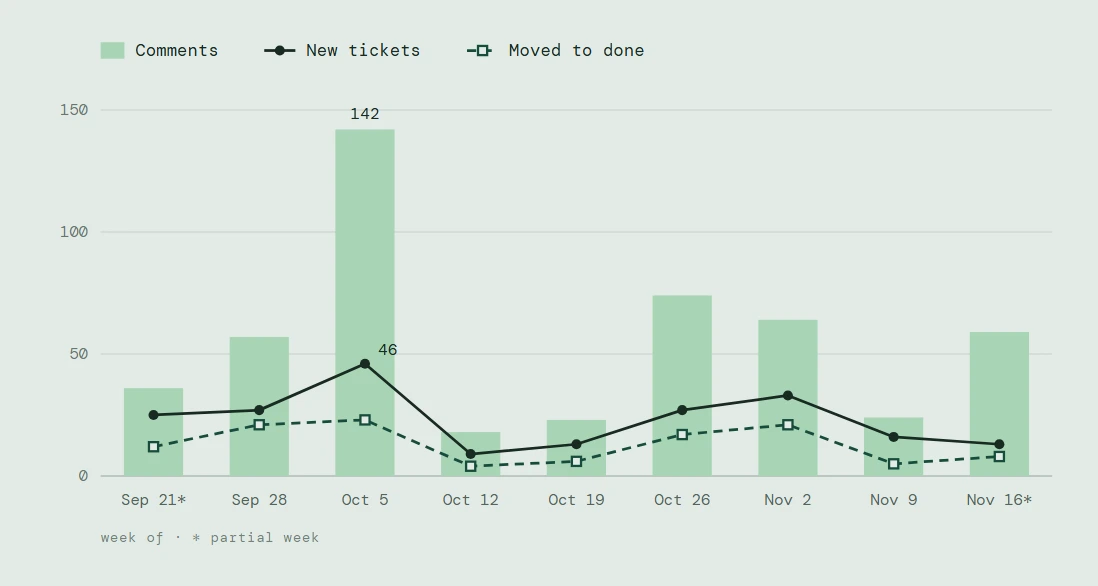
In its first nine weeks, the second version got 209 tickets and 497 comments, and 117 tickets were moved to done. The busiest week was October 5. The two quiet weeks after it overlap with the start of the entity research, which ran outside this board.
Weekly numbers behind the chart
| Week of | New tickets | Moved to done | Comments |
|---|---|---|---|
| September 21* | 25 | 12 | 36 |
| September 28 | 27 | 21 | 57 |
| October 5 | 46 | 23 | 142 |
| October 12 | 9 | 4 | 18 |
| October 19 | 13 | 6 | 23 |
| October 26 | 27 | 17 | 74 |
| November 2 | 33 | 21 | 64 |
| November 9 | 16 | 5 | 24 |
| November 16* | 13 | 8 | 59 |
* Partial week.
Testing the app on my own site
My own site, kk.coach, is where the content layer was tested first. I rebuilt it from scratch this autumn, moving it from WordPress to Astro and Cloudflare Workers, and it is so far the only site where the content layer has been measured end to end.
The first audit, run on November 4 with the research code that became the content layer, found problems I had written myself:
- the web analytics page said “web analytics” in its title and “measurement” in its body;
- one service page used my own name for the service, with no known category next to it; it is now the organic search growth system page;
- the generative engine optimization (GEO) page mentioned answer engine optimization (AEO) and retrieval-augmented generation (RAG) without explaining them.
All of these are fixed on the live site. Since then I open each page and, where it fits, each section with its concept as the subject of the first sentence, and this article follows the same rule.
In the latest run, nine of my eleven service pages cover at least two-thirds of the concepts that belong to their topic. The two broad overview pages explain about half, and most of what they leave out is explained elsewhere on the site.
Where the app stands and what comes next
The AAA app is in use on my own projects and isn’t public. The content layer is now being measured on a second site, because numbers tuned on one site aren’t rules yet. When the app gives answers I would sign on sites I didn’t build it on, I will make it publicly available, possibly as a subscription.
My goal is the full SEO audit, automated. What the app covers today is machine-view SEO, and two parts are missing. The first is off-site signals: which sites link to a company, where it is mentioned, and how AI assistants describe and recommend it. The second is the human view: whether a page answers the buyer’s question and leads them to get in touch, which I check by hand today. Search data from Search Console and rank tracking also still comes from other tools. If the app can measure off-site signals and the human view as well, one audit will give a full picture of a website.
What the app changes in an SEO audit
The app changes which questions an SEO audit can answer in four working days. Crawling a site and finding its technical errors is the part any tool can do. The question AI search made urgent used to take page-by-page manual work: how broadly and how deeply does each page cover its topic, and can its text be quoted in an answer? The app answers that with evidence I can check, so the audit can point the implementation budget at the pages that need it.
What investments are required for SEO in an AI era? shows where the audit sits in a six-month SEO budget, and How can we ensure brand presence and preference in a world of answer engines? covers what happens beyond your own site. The SEO consulting and generative engine optimization pages describe the work in detail.