How can we ensure brand presence and preference in a world of answer engines?
What it takes for AI assistants to name and cite a company, and then to recommend it: readable pages, original content, digital PR, and a monthly check on presence and preference.
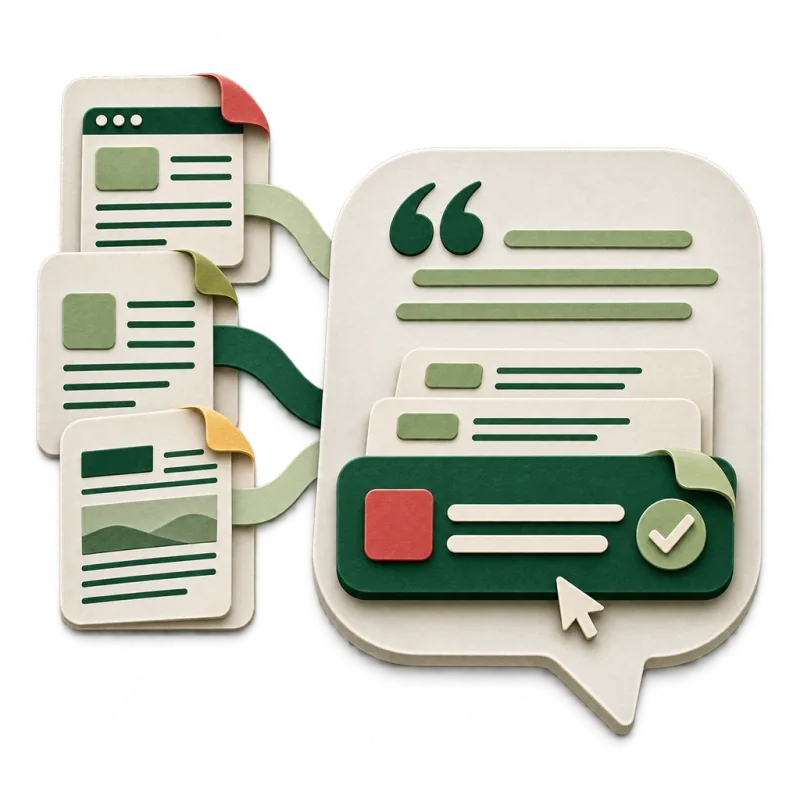
Brand presence in answer engines is whether AI (artificial intelligence) assistants such as ChatGPT, Gemini or Google’s AI Overviews name a company or cite its pages when a buyer asks a question that company can answer. Brand preference is the step after that: the assistant recommends the company for the buyer’s situation, and the buyer agrees. The question in the title comes from Gartner, which lists it among the top questions chief marketing officers (CMOs) ask about answer engines in The CMO Report for the third quarter of 2026. The same report says 45% of business-to-business (B2B) buyers already use AI tools to identify suppliers.
I answer it as an SEO (search engine optimization) consultant. In my experience, presence is earned in three places: a page the assistant can read, something on that page only your company can say, and other websites that talk about you. Preference is a separate result. Part of what follows is documented in other people’s studies and part is my own experience and assumption, and I say which is which.
Brand presence and brand preference are two results
Brand presence means the company shows up in the answer: it is named, or one of its pages is cited as a source. Brand preference means the answer recommends it. I keep the two apart because in my monthly checks the page an answer cites and the supplier it recommends are often different companies.
Take a company that sells scheduling software to field-service businesses, the example I also use in What investments are required for SEO in an AI era? A buyer asks an assistant which scheduling tool syncs with their CRM (customer relationship management) system and suits a team of twenty technicians. The assistant can cite the company’s integration page for how the sync works, and still recommend a competitor for a team that size. The company was present in that answer, and a competitor was preferred.
Gartner’s report notes that buyers turn to answer engines mainly to learn about a category, compare options and choose between them. Those comparison and selection questions are the ones worth being present for.
This maps onto the split I use for all SEO work. Machine-view SEO is the part of search engine optimization that deals with how a website looks to the systems that crawl, index and interpret it, and the human view is how the same site looks to a buyer. Presence is mostly a machine-view SEO result, plus what happens on other websites. Preference is where the human view comes back in.
A page an answer engine can read and quote
A page is readable to an answer engine when its content is in the page source the server sends, and quotable when each section makes sense on its own. I check four things on a page.
Rendering. Vercel and MERJ analyzed crawler traffic in late 2024 and found that the AI crawlers they tracked, OpenAI’s and Anthropic’s among them, fetched JavaScript files but didn’t run them (Vercel). Content that only appears after JavaScript runs in the browser may not exist for those systems. For Google, Search Console shows what was indexed. AI systems don’t report that, so the server logs are the evidence I have: they show whether an AI crawler fetched a page, not what the system kept.
Passages. AI search systems can retrieve single passages, by exact terms and by meaning. In Daniel Shashko’s May 2026 analysis of 153,425 citations across six AI platforms, 84.1% of Gemini’s citations linked to the exact sentence they used; Google AI Mode did so for 70.9% of its citations in March 2026 and had stopped by May (GitHub). So I check that each section names its subject and can be quoted without the rest of the page.
Position. In Kevin Indig’s analysis of 18,012 ChatGPT citations, 44% came from the first 30% of the page text (Search Engine Journal). It is one platform and a correlation, and I still put the answer near the top.
Several searches. When I tested one question on November 18, 2026, ChatGPT Search showed three searches and Gemini returned four, one run each. A page written around a single keyword may not contain the passage the narrower searches look for.
I also keep the headings in a logical order and the server fast. Google documents that it crawls less when a server responds slowly (Google); that AI crawlers behave the same way is my assumption. None of this is a known ranking factor for AI answers. The aim is content that is easy to reach.
Original content: what only your company can say
In my view, it matters little whether AI helped write a page; what earns a citation is original content that states something no other page can—your own data, your own observation, or your own position. If a page only repeats what is already on ten others, AI search systems don’t need it. They can compare text by meaning, so when several pages make the same point in different words, they compete for the same place in the answer, and the assistant needs only one of them. That is my assumption from watching which pages get cited. Don’t take it from me; test it on your own pages.
The closest published evidence is the 2023 study that gave GEO (generative engine optimization) its name. Gartner calls the same work answer engine optimization (AEO). The study tested content changes on a benchmark and found that adding statistics, quotations and cited sources raised a source’s visibility in generated answers by up to 40% (arXiv). It measured a test setup and says nothing about originality as such, but it suggests that concrete, attributable facts get used.
For the scheduling software company, the original material already exists inside the business: which CRM versions the sync supports, how long setup takes for a typical customer, which questions the support team hears most. A competitor’s site can’t have it.
Digital PR: what other websites say about your company
Once a company’s own pages are in order, brand presence in AI answers is most often decided elsewhere—through digital PR (public relations), the work of earning links, mentions, and citations on websites you don’t own. Answer engines lean on third-party sources. For the scheduling software company those are comparison articles, review sites, trade publications, integration directories and forum threads, and its own site is one voice among them.
Ahrefs studied 75,000 brands and found that mentions of a brand across the web correlated much more strongly with appearing in Google’s AI Overviews (0.66) than its number of backlinks did (0.22) (Ahrefs). In a later round, mentions on YouTube had the strongest correlation of the factors tested, about 0.74 (Ahrefs). Ahrefs itself says these are correlations. I don’t read them as mentions against links, because a link is a mention too, and I count both.
Forums matter as well, and they show how unstable this is. Peec AI found Reddit to be the most-cited domain across five AI search surfaces in an analysis of 30 million sources in the US (Peec AI). Semrush tracked Reddit in nearly six out of ten ChatGPT responses in early August 2025 and in roughly one in ten by mid-September (Semrush). A plan built on one platform can lose its footing within a month.
I call it digital PR because most of the work is earning a place in what other people publish, and link building is only one part of it. I start with a strategy drawn from what the audit recorded: which sources the answers cite for the buyer questions, where competitors are named and the company isn’t, and which of those places the company can earn a spot in. For the scheduling software company that could be the CRM vendor’s integration directory, two comparison articles that leave it out, and a trade publication that would run its customer data. The links and mentions are then earned with useful content, data and partnerships.
People at the company can take part too: a reply in a forum thread or a comment under a YouTube video from the company’s account may count as a mention. I can’t prove it, because the Ahrefs study counted video titles, transcripts and descriptions, and doesn’t mention comments. If the team does this, it needs rules: answer the question that was asked, say who you are when it is relevant, and mention competitors only in positive or neutral terms. In my experience, dismissive or negative posts do more harm than good.
I don’t promise that this work gets a company into AI answers. How these systems choose their sources isn’t published, and the answers change even when nothing on your side does.
Brand preference: from being cited to being recommended
Getting cited puts your company in the answer; earning brand preference means the assistant recommends you for the buyer’s specific situation—and the buyer agrees. Moving from one to the other comes down to three things.
The first is accuracy. An assistant can only recommend what it can describe, so I check whether it states the product, the pricing model and the limits correctly. When a wrong detail keeps coming back, I trace it to its source and fix it there, on the company’s own page or with whoever published it. The company name and description also have to be the same everywhere, so these systems see one company.
The second is fit. A recommendation is made for a situation: a team of twenty, a particular CRM, a budget. If no page says who the product is for and who it isn’t for, the assistant has little to match against the buyer’s question. This is my reading of the answers I review, and I haven’t seen it documented.
The third is the buyer. A buyer who clicks through lands on the page the assistant cited, and the human view takes over: does the page answer the question they came with, do they trust it, and do they ask for a demo?
Measuring brand presence and preference
To track brand presence and preference over time, I run a fixed set of buyer questions on the same platforms every month and record five things: whether the company is mentioned, whether it is recommended, whether it is described accurately, whether its own pages are cited, and who else appears. Gartner’s report points the same way for dashboards: add citations and brand mentions next to clicks, because more answers now satisfy the search without a visit.
The platforms’ own reports cover part of this. Google Search Console doesn’t separate AI Overviews from standard search results, yet the queries a site appears for still offer useful clues: longer, question-like queries often point to AI Overview appearances, though they can also be query fan-out sub-queries (the narrower searches an AI system runs behind a single question). For Microsoft Copilot, Bing Webmaster Tools gives a similar view, and ChatGPT’s Business Hub shows how often a site was mentioned. Useful as they are, none of these reports shows where the company stands against competitors. One run is one observation, and answers change without any change on the site, so I read the trend over several months.
Ensuring brand presence and preference: the short answer
Ensuring brand presence in answer engines takes three kinds of work: pages an assistant can read and quote, content only your company can provide, and a reputation on other websites. Preference comes after presence. It depends on whether the assistant can describe accurately who the company is right for, and whether the page convinces the buyer who clicks through.
What investments are required for SEO in an AI era? puts hours and fees on this work, and Why I built my own SEO audit app shows how I audit the on-site part. The off-page SEO and generative engine optimization pages describe the services in detail.