

Most B2B companies first notice the impact of AI search as a traffic problem. Fewer organic clicks. Stranger query patterns. Lower CTR. Leads that seem to arrive later than they used to. At first, this looks like an SEO warning signal, but in practice the change is bigger than that.
It is not simply that AI is taking away a few clicks. What is really happening is that the early part of the buyer journey is increasingly happening outside the company’s own website. The buyer does not necessarily open five blog posts, three category pages and two comparison pages anymore. They ask an AI system. They ask for a shortlist. They ask for pros and cons. They ask for alternatives. They ask what they should pay attention to before choosing a vendor.
And by the time they first arrive on your website, in many cases they are no longer a cold visitor. They already have a rough view of the market. They have already heard of competitors. They have seen some kind of comparison. They may already have a half-formed shortlist.
That is a very different situation from the one classic B2B SEO and demand generation were built around.
The old question: how much traffic did we lose?
A lot of reporting still starts here. How many organic sessions disappeared? How much did CTR fall? Which top-of-funnel article brings fewer visits than before? These are fair questions. They are just not enough.
I have seen projects where top-of-funnel content declined in traffic, while demo pages, comparison pages and pricing-related pages became relatively more important. If you only look at session volume, that looks like bad news. If you look at it from a pipeline perspective, the picture becomes more nuanced. Fewer people may be coming in, but the people who do arrive may be closer to a decision. This is not always true. In some markets, traffic loss simply hurts, and there is no hidden improvement in lead quality behind it. But in B2B, it is increasingly common to see a pattern where early research is outsourced to the AI layer, while the company’s own website receives visitors later, and often with more context. Put simply: the website is becoming less of a first explanation point and more of a validation point.
What is actually changing?
From a marketing-only point of view, it is easy to see this as fewer clicks. From a business point of view, the buying process itself is changing shape. Previously, a company had more chances to educate the visitor on its own site. A good top-of-funnel article brought the user in, they moved to related content, subscribed, downloaded something, and came back later. Today, part of that process may happen before the visitor appears in any analytics system at all. That is why AI search is not just an SEO issue. It affects sales, pricing communication, customer success content, product positioning, CRM fields and whether the company is represented as a clear entity in the market. A B2B buyer can now easily ask: Which solution is better for a mid-sized manufacturing company if integration and fast implementation are important? They are not expecting a keyword-based list of blue links. They expect interpretation. AI will assemble that interpretation from somewhere. If a company’s content is vague, weak on proof, or full of generic claims, it can easily be left out of the answer.
The impact does not show up in one place. Based on the research material, the impact areas of AI search in B2B can be understood like this. Not as a market benchmark, but as a practical way to allocate leadership attention.
Estimated relative weight of B2B AI search impact areas
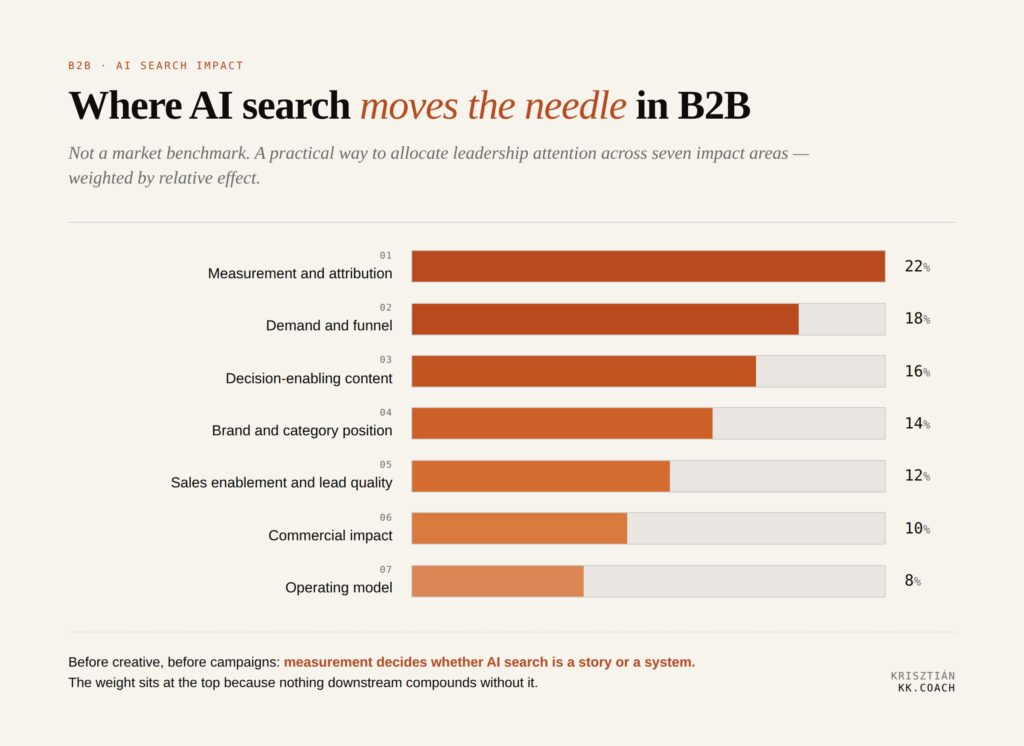
The reason this view is useful is that it shows why treating AI search as a purely technical SEO project misses most of the problem. Measurement and attribution are critical, but right after that come the funnel, content, brand interpretation and sales operations. Measurement will be the first big frustration. One of the most common complaints is completely valid: We cannot properly see where these leads are coming from.
The impact of AI search often does not appear as a clean referral. There is visible AI referral traffic, but there is also influence that never shows up directly in web analytics. A buyer may research with AI, encounter the brand there, and then come back later through direct traffic, branded search or a link shared by a colleague.
If you only look at default channels, the picture becomes distorted. Marketing says organic is down. Sales says prospects are more informed. Leadership does not know whether that means the situation is bad or simply different. In many cases, the answer is that the measurement system was not designed for this buyer journey.
In practice, at least four layers need to be connected: search data, web analytics, CRM and sales feedback. It is not enough to know whether there was an AI referral session. You also need to know which lifecycle stage the lead moved into, how quickly sales responded, which competitors the buyer compared you with, and what they said about how they found the solution. Many companies do not measure this. Not because it is theoretically complicated, but because operationally, no one owns it.
The new shape of the buyer journey looks roughly like this:
Before:
Keyword search
- TOFU clicks
- Website-led education
- Nurture
- Shortlist
- Sales-led validation
Now:
Complex question to AI
- AI summary or zero-click answer
- Early shortlist inside the AI layer
- Later, higher-intent click
- Proof, pricing, security, implementation
- Sales and procurement validation
This shift matters because most B2B content strategies are still optimized for the first model. Many general blog posts, not enough real decision-enabling content. Many “what is X?” articles, not enough content around when a solution is not a good fit, how it compares to alternatives, what integration risks exist, or what implementation actually looks like in practice. In an AI search environment, those questions become much more important.
Top-of-funnel content does not disappear. Its role changes.
I would not say that top-of-funnel content becomes useless. That would be too strong. What changes is that some TOFU content no longer works primarily to win a click. It works so the system can understand it, quote it, retrieve it and connect the company to a topic. That requires a different way of writing. Vague, long, generic articles become less useful. Clear definitions, short answer blocks, comparable claims, examples, evidence-backed statements and pages that support decisions become more useful. On a B2B website, for example, it is not enough to say that you offer a flexible, scalable solution. That means almost nothing. You need to show what type of company it is for, in which situation, compared to which alternative, under what implementation conditions, and with what proof. This helps AI systems. More importantly, it helps buyers. Brand is no longer just awareness. One uncomfortable lesson of AI search is that brand is not only a communication issue. It is also a machine interpretation issue.
If it is unclear what a company does, who it helps, which category it belongs to, how it is different, which use cases it is strong in, and what external proof supports it, AI systems will also handle it with more uncertainty. Not because of bad intent. Simply because there are not enough clean signals.
Many B2B companies struggle here because their own websites are too generic. “Innovative platform”, “End-to-end solution”, “Digital transformation”, “Efficiency improvement”. These phrases are hard for humans to differentiate. They are not much easier for AI systems either. In practice, the first step is often not technical optimization, but category clarification. What do we do? For whom? When are we a good choice? When are we not? What problem are we an alternative to? What proof do we have? Where is this confirmed outside our own website?
That does not sound like a classic SEO task. Still, it has a strong impact on AI search visibility. Sales meets the buyer later, but that does not always make the job easier. Many companies would like prospects to arrive more informed. That is understandable. But a more informed buyer is not always an easier buyer.
They may already have compared three alternatives. They may have received a partly inaccurate answer from AI. They may arrive with pricing expectations taken from a table, a forum thread or a summary. They may already have a list of objections.
In that situation, sales does not need a generic presentation. Sales needs precise proof. Implementation material. Security answers. Migration explanations. TCO logic. Content that can be used quickly and that does not merely sound good, but reduces decision risk. This is why AI search does not stop at marketing. If sales enablement material is weak, even higher-intent AI-influenced leads can be lost.
What should be fixed first?
I would not start with another hundred-point SEO checklist. For most B2B companies, three things should come first.
First: how do we measure AI influence? Not perfectly, because perfect measurement is not realistic right now. But there should be a separate AI referral view, a self-reported source field on important forms, an AI-influenced lead or opportunity field in the CRM, and sales feedback about what information the buyer brought with them.
Second: which decision-enabling content is missing? This is not about writing the next general blog post. It is about comparison, alternatives, integration, security, pricing logic, procurement FAQ, implementation, migration, ROI and customer proof pages. These pages often do not bring spectacular top-of-funnel traffic, but they are much closer to revenue.
Third: how clear is the company’s entity and category position? If you cannot explain in three sentences to a buyer or an AI system who you are, who you help and what you are a strong alternative to, that has to be fixed first.
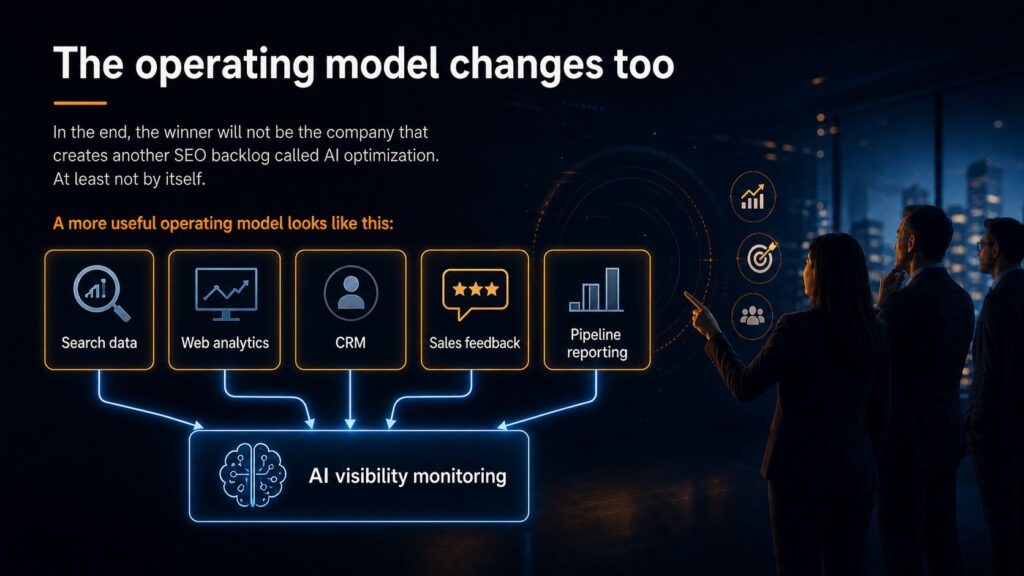
This means that content, SEO, product marketing, sales, RevOps and customer success are not trying to interpret the same phenomenon separately. There is shared measurement. There is a shared taxonomy. There is feedback on what AI systems say about the company, what they misunderstand, where they do not mention it, and which competitor names they bring into important buyer questions.
This part is not glamorous. It does not feel like launching a new campaign. But in many cases, this is where the difference is made between a company that actually adapts to AI search and one that simply publishes a few AI-ready pages. The lost click is not the only risk. The biggest risk is not necessarily that fewer people click through. The bigger risk is being left out of the early shortlist. If the buyer creates a three-to-five-vendor list during their first AI-assisted research session and you are not on it, it becomes much harder to enter the process later.
That is why AI search should be treated less as a traffic disturbance and more as a change in the revenue system. The question is not only how much organic traffic we lost. It is also whether we appear for the important buyer questions, whether AI systems understand us correctly, whether we have enough proof, whether sales can see what the buyer already learned, and whether we can connect all of this to pipeline data.
Not every B2B company will be affected in the same way. It depends on the category, deal size, sales cycle, brand awareness and how complex the buying decision is. But the direction is fairly clear: parts of discovery, comparison and validation are moving into an AI-mediated information layer.
A company that looks at this only as an SEO traffic issue will probably underestimate the shift. A company that also works on the buyer journey, content, brand interpretation, sales and measurement has a much better chance of not only staying visible, but also coming out of this transition in a stronger business position.