
The Organic Growth System
Most companies don’t have
a marketing problem.
They have a system problem.
SEO, UX, and conversion optimization, are treated separately, each having their own vendors, their own metrics, and their own definitions of success. It is because of that fragmentation that organic growth will stall, even though individual channels may appear successful.
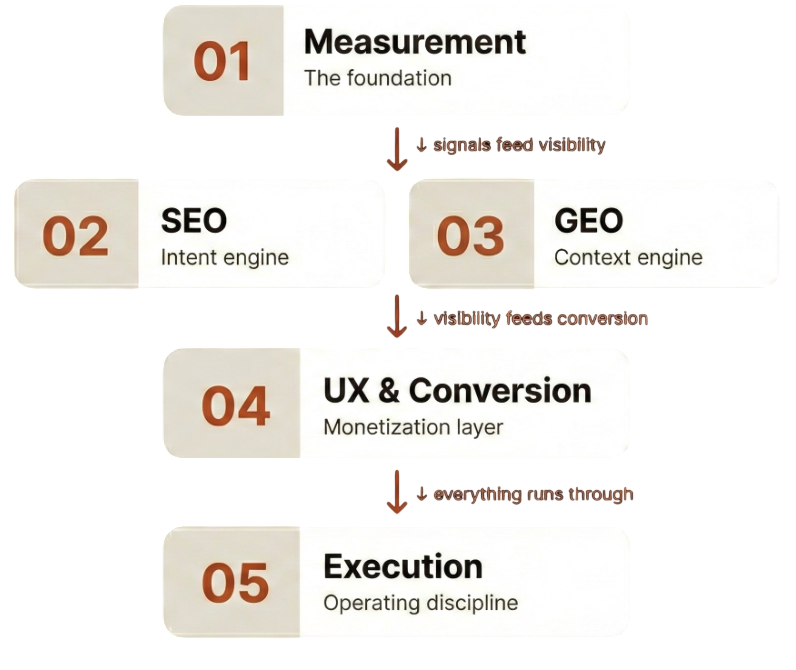
Organic growth is a stack, not a channel.
Each layer builds on the previous one. Measurement provides the signal. SEO and GEO provide visibility. UX reduces the friction. Conversion provides the value. Execution enables the process to be executed in a controlled, repeatable manner.
If one layer is weak, the entire system will be subpar — and you will know it from the numbers long before you know which layer caused it to break.
Therefore, while optimizing a single channel may solve the symptom of the problem, it will rarely address the root cause. The problem is nearly always “the layers are not working together.”
If you can’t trust the data,
every decision is a guess.
Most companies have analytics installed. Very few have analytics that actually tells them what’s happening. Events fire on the wrong triggers. Conversions are counted inconsistently. Attribution assigns revenue to the last click, ignoring everything organic did to earn it. The dashboard exists — but the decisions it produces are no more reliable than intuition.
This is where every engagement starts. Before strategy, before prioritization, before any optimization work — the measurement layer has to be trustworthy. That means connecting GA4, Search Console, behavior data, and server logs into a structured data foundation in BigQuery, with a Looker Studio layer that answers business questions, not just traffic questions.
Measurement isn’t reporting. It’s the infrastructure that makes every other layer work. Without it, you can’t tell whether an SEO improvement drove leads, whether a UX change lifted conversion, or whether the traffic you’re getting is the traffic you actually want.
Without this layer
- Organic impact is invisible — SEO gets no credit for assisted conversions
- Decisions are based on whichever metric is most convincing, not most accurate
- You can’t tell if a change worked, so you can’t repeat what works
- Paid channels look more effective than they are, because organic attribution is broken
When it works correctly
- Every decision has evidence behind it — prioritization stops being political
- You can attribute revenue to specific organic changes with confidence
- Sprint reporting answers “what changed” not just “what we did”
- The system learns — each cycle produces better hypotheses than the last
Rankings are a proxy.
The real question is: what happens after the click?
Most SEO work focuses on getting to page one. That’s a reasonable starting point — but it’s not the goal. The goal is to capture demand at the moment it exists, and convert it into a business outcome. A page that ranks and doesn’t convert is an expensive distraction.
The SEO layer addresses three things simultaneously: the technical foundation that lets search engines understand and trust your site, the information architecture that maps your content to how your customers actually make decisions, and the content structure that aligns each page with a specific intent stage — not just a keyword.
Every search query reflects a decision in progress. Someone diagnosing a problem needs different content than someone comparing providers. Someone evaluating risk needs different signals than someone ready to commit. SEO done correctly treats these as distinct moments — and structures the site to serve each of them.
When this layer is weak
- Traffic comes from informational queries that never convert to pipeline
- Authority is spread thin — no page ranks strongly for anything that matters commercially
- Technical issues prevent crawling, indexing, or rendering — silently bleeding performance
- Competitors own the decision-stage searches where buying intent is highest
When it works correctly
- Organic traffic is qualified — visitors arrive already oriented toward your solution
- Authority concentrates on pages that drive commercial outcomes
- The site earns compounding visibility without proportional increase in ad spend
- You own key decision moments that competitors are paying to appear in
Search has changed.
Decision-makers now ask instead of search.
A growing portion of research is being conducted within generative systems — ChatGPT, Gemini, Perplexity. Someone evaluating agencies does not merely conduct a Google search anymore. Instead, they inquire with an AI to compare alternatives, describe methods and techniques, and suggest service providers. If your brand is not included in the response provided by the AI, then your brand does not exist during that particular moment of evaluation.
Generative Engine Optimization is not a new SEO tactic. Rather, it is a new layer of visibility that uses different logic. Search Engines determine the ranking of pages. Generative Systems create entities from available information. As such, your brand needs to be represented as a well-defined, contextually-related entity with consistent positioning, well-defined expertise signals, and content that has been written to be synthesized (i.e., used to create an answer) rather than merely indexed.
Not appearing in AI-generated answers isn’t neutrality. It’s absence. And in competitive categories, absence is increasingly expensive.
When this layer is weak
- AI systems reference competitors when prospects ask for recommendations in your category
- Your brand exists as a page, not an entity — meaning context and relationships aren’t understood
- Content is indexed but not synthesizable — AI can’t easily extract and cite what you do
- Authority is fragmented — different parts of the site signal different things
When it works correctly
- Your brand appears in generative answers when prospects ask about your category
- Positioning is consistent and structurally reinforced across the entire site
- Content is structured for citation — definitions, frameworks, and evidence are easy to synthesize
- Authority compounds — GEO strengthens SEO, and SEO strengthens GEO
More traffic won’t fix
a site where visitors don’t convert.
When traffic increases but revenue remains static, the immediate reaction is to evaluate acquisition — through improved targeting, new marketing channels, etc. However, the problem is typically downstream. While visitors arrive, explore your website and leave without taking action — this is a conversion problem — and increased traffic will only amplify this problem.
In this context, UX optimization is not about design or redesign — it is about decision architecture: does the visitor immediately understand exactly what this is and whether this is relevant to them? Is the page layout directing the visitor toward a decision or allowing them to wander? Are there friction points (slow load time, unclear next steps, trust issues) present in the data prior to the visitor feeling those issues in the numbers?
The highest-ROI work is often fixing what’s already getting traffic. A 2x improvement in conversion rate is worth more than 2x the traffic — at zero additional acquisition cost. This is the layer where the other investments pay off.
When this layer is broken
- High-intent pages have high bounce rates — visitors arrive qualified and leave unconverted
- Form completion rates are low despite relevant traffic
- Users reach decision-stage pages but don’t take the next step
- Paid acquisition keeps rising because organic never compounds
When it’s working
- Existing traffic produces more leads without increasing acquisition spend
- The path from arrival to conversion is clear — visitors know what to do next
- Friction is identified in data before it shows up in missed revenue
- SEO and UX reinforce each other — better experience signals support search authority
A strategy that doesn’t ship
is just a well-formatted opinion.
Organic growth has the biggest problem with poor strategy execution. The strategy for organic growth is executed when an audit is done, a roadmap is created, and priorities are decided on. However, after this, no action is taken as the gap between knowing how to execute a strategy and having someone with the right skills to execute it is much too large.
All initiatives at Organic Growth use a sprint based approach to deliver; diagnosis, prioritization of projects by business impact, delivery, and measurement. All sprints run in two week cycles. Where possible, each sprint delivers in WordPress and WooCommerce, and if required, uses structured project management within an internal team to deliver a project. No 60 page roadmaps are developed that sit idle, and all projects are handed off directly to a developer that understands the strategy behind the project.
It is through execution that compounding occurs. Each sprint produces information that will improve the next sprint. The system becomes smarter, faster and more focused on what is actually driving results (not what sounded good in a strategy session).
Without execution discipline
- Recommendations accumulate but nothing is implemented — the backlog grows, results don’t
- Strategy and implementation are handled by different people, and context is lost in the handoff
- There’s no feedback loop — you don’t know what worked because you weren’t measuring the right things
- Six months in, the situation looks similar to six months ago, just with more documentation
With structured execution
- Changes ship every sprint — the roadmap shrinks rather than grows
- Strategy and implementation stay connected — one person holds context end-to-end
- Each cycle produces a measurable result and a better hypothesis for the next
- Progress is visible and attributable — not just to you, but to anyone who n
What to expect
Organic growth produces
measurable business signals —
if the system is built right.
These aren’t guarantees. They’re the signals that move when each layer is properly implemented and measured. What you see depends on your baseline — but these are the indicators worth tracking.
Layer
What changes
Business signal
Typical horizon
Layer 01
Measurement & Data Architecture
- Events fire correctly and consistently across the funnel
- Attribution reflects what organic actually contributed — not just the last click
- Decisions are made from data, not from dashboards that look complete but aren’t
- Organic channel’s true contribution to pipeline becomes visible
- CAC calculation includes organic, making paid vs. organic trade-offs legible
- Reporting earns trust with stakeholders because it’s auditable
2 – 6 weeks
to accurate baseline
Layer 02
SEO
- Crawl budget is used efficiently — search engines index what matters
- Content aligns with decision stages, not just keyword volume
- Internal authority flows toward pages that drive commercial outcomes
- Organic traffic quality improves — more intent-matched visitors, lower bounce on key pages
- Organic contributes more qualified leads over time, reducing paid dependency
- Lower organic CAC as compounding takes effect — unlike paid, the asset appreciates
3 – 6 months
for meaningful signal
Layer 03
GEO · AI Visibility
- Your brand is structured as a clear entity — name, expertise, context all legible to AI systems
- Content answers decision-stage questions directly, in the format AI systems can cite
- External signals reinforce your positioning across sources AI models are trained on
- Brand appears in AI-generated answers where competitors currently dominate
- Share of voice in generative results increases over time — especially for comparison and evaluation queries
- Brand recognition grows among buyers who research via AI before ever visiting your site
2 – 5 months
for citation presence
Layer 04
UX & Conversion
- Friction points are identified in behavioral data before they’re guessed at in meetings
- Page structure and CTAs reflect how visitors actually decide — not how the site owner assumes they decide
- Every significant change is tested and measured, not shipped on instinct
- Conversion rate improves — the same traffic produces more leads or transactions
- Revenue per session increases as high-intent visitors hit fewer dead ends
- Effective CAC drops: you’re getting more from the acquisition spend you already have
4 – 10 weeks
per tested change
Layer 05
Execution
- Recommendations ship — the backlog shrinks rather than accumulates
- Each sprint produces a measurable result and a sharper hypothesis for the next
- Progress is visible and attributable — to you, and to anyone else who needs to see the ROI
- Compounding begins: early wins create the data that makes subsequent decisions faster and more precise
- The system improves itself — each cycle produces less guesswork and more leverage
- LTV of the organic channel grows as the asset is maintained and extended, not just deployed once
Ongoing,
sprint cadence
Where to start
Not every company needs
all five layers at once.
The first step is identifying which layer is actually limiting performance. Here are the most common situations — and where the work typically starts.
Situation 01
“Traffic is growing, but leads and sales aren’t following.”
The acquisition side is working correctly. There is something downstream that is not functioning properly; either the wrong traffic is coming to the website (intent) or the correct traffic is going to the website but the website is not converting them (friction)…usually both. To fix this, we start with measurement to identify where the actual gap exists in the process and then we focus on fixing the UX and conversion.
Measurement
UX & Conversion
Situation 02
“We’ve invested in SEO before. It didn’t produce results.”
Most often when this occurs, there are three underlying causes that exist; the technical foundation is leaking authority, the content is created around keywords instead of the stages of decision-making, or the implementation did not occur. We first determine why the issue occurred (the root cause) and then we implement the solution to fix the issue, not just treat the symptoms.
Measurement
SEO
Execution
Situation 03
“Traffic is growing, but leads and sales aren’t following.”
The acquisition side is working correctly. There is something downstream that is not functioning properly; either the wrong traffic is coming to the website (intent) or the correct traffic is going to the website but the website is not converting them (friction)…usually both. To fix this, we start with measurement to identify where the actual gap exists in the process and then we focus on fixing the UX and conversion.
SEO
GEO
Measurement
Situation 04
“Our competitors are appearing in AI answers. We’re not.”
We operate generatively using entity and authority logic, not keyword logic. When competitors are being referenced and you are not, it is typically due to their positioning being cleaner, their content being more organized, and their topical authority being stronger. Our geographic work begins with entity architecture and continues into content reorganization and internal linking.
Geo
Not sure which layer
is your bottleneck?
Share your website and one sentence about what isn’t working. I’ll review it and tell you where I’d start — and why. No pitch, no generic audit.